
PELONI: Qatar’s fake fact-checking system is simultaneously targeting US citizens… Seems like a rather important dilemma for a US administration which is brimming over with Qatari pundits and Qatari aligned policy makers… Washington needs to rid America of its Qatari influence peddling. Trump once advocated for this very thing before his first term. He should return to doing so. Qatar is not an advocate for America, but is instead a Muslim Brotherhood regime which is responsible for financing terror across the globe and this financing includes having assisted the lead up to the 9/11 attack in NYC.
Max Lesser & Maria Riofrio | Oct 1, 2026
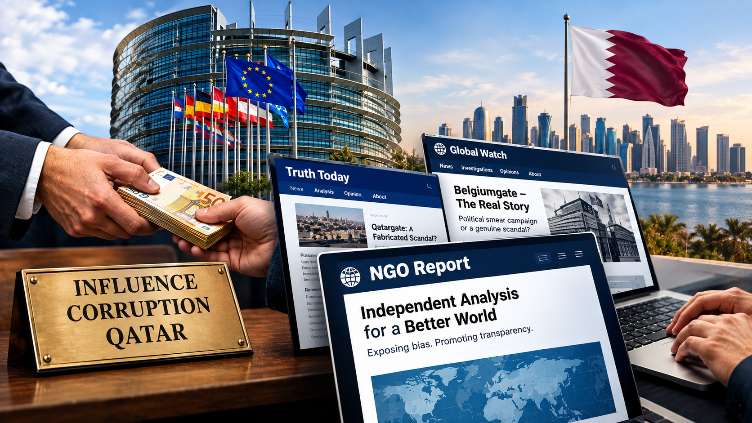 Click Image to Enlarge. Image created via AI.
Qatar’s attempts to buy influence around the world aren’t always subtle or — according to Belgian prosecutors — legal. But that is no secret. What remained hidden until now is that the most vocal critics of the prosecution are not independent news sites, but rather a network controlled by a single creator, likely acting at Qatar’s behest.
On December 9, 2022, Belgian authorities carried out raids in Brussels and arrested several members of the European Parliament (MEPs) and their staffs after uncovering a corruption scheme linked to Qatar.1 Police found around 150,000 euros ($159,000) stored in bags inside the Brussels residence of Eva Kaili — a Greek MEP who was then one of the vice presidents of the European Parliament — and separately caught her father attempting to remove another 750,000 euros (about $795,000) in cash from the apartment.2 Further investigations found that Kaili and her partner, Francesco Giorgi, purchased roughly 7,000 square meters (1.7 acres) of land on the sought-after Greek island of Paros, a purchase investigators suspected may have been used to launder proceeds from the bribery scheme.3 Six days after the raids began, the European Parliament adopted a resolution supporting the ongoing Belgian criminal investigation and calling for broader investigations into foreign interference and corruption linked to Qatar.4 The raids marked the public emergence of a probe that had been underway for more than a year and subsequently expanded into a sprawling, multiyear case.5 To date, none of the cases has gone to trial. The defendants challenged the validity of numerous investigative acts, but a court ruling in February 2026 rejected their efforts, allowing the case to proceed.6
Authorities also determined that former Italian MEP Antonio Panzeri established a human rights nongovernmental organization, Fight Impunity, which served as institutional cover for receiving illicit payments from Qatar.7 Police found approximately 600,000 euros ($635,000) in cash at Panzeri’s residence. In addition, Luca Visentini, then secretary-general of the International Trade Union Confederation, received less than 50,000 euros (about $53,000) in cash routed through Panzeri’s organization.8 Overall, Belgian prosecutors charged five current or former MEPs in connection with the probe.9 The scandal became known as Qatargate.
Less than two months after the first raids, beginning on February 7, 2023, a network of websites posing as watchdog organizations and news outlets began publishing content that attempted to discredit the findings of Belgian law enforcement. The websites claimed that Belgian authorities had fabricated the Qatargate investigation in coordination with Doha’s rival, the United Arab Emirates (UAE), and argued that the scandal should be renamed “Belgiumgate.” The sites consistently framed Qatar as the victim of politically motivated smear campaigns rather than a party to the corruption scandal. Moreover, they consistently inflate genuine friction in the long, slow, and procedurally imperfect judicial process, turning it into alleged evidence of a systemic anti-Qatar conspiracy.
In October 2025, one of the fake watchdogs, NGO Report (ngoreport[.]org), came to the attention of FDD’s Center on Cyber and Technology Innovation (CCTI) when it published articles critical of FDD and added FDD to its “blacklist” of biased organizations.10 NGO Report presents itself as an independent evaluator of other organizations’ objectivity but primarily publishes content targeting those it portrays as aligned with the UAE, Israel, and several other countries, while framing Qatar as the target of disinformation. Based on an investigation of the website’s hosting infrastructure and other technical indicators (see Appendix A), NGO Report appears to share a common creator with at least four other websites, all under the control of a single operator: Anti-Money Laundering Network (amlnetwork[.]org), Brussels Watch (brusselswatch[.]org), Inform Europe (informeurope[.]com), and Evening Star (eveningstar[.]uk). These websites similarly present themselves as watchdogs, investigative, or news outlets and publish overlapping narratives that dismiss the Qatargate corruption scandal and criticize Qatar’s regional rivals while portraying Qatar in a favorable light.
An advertisement on Evening Star for an obscure electric scooter website, electricscooterx[.]com, turned up a half-dozen additional sites in the Qatar-aligned network. The ad for the scooter site stood out both because of the site’s obscurity and because Brussels Watch and Inform Europe either currently or previously ran ads for it.11 An examination of other websites that advertise electricscooterx[.]com led to Nordic Rights (nordicrights[.]org), another purveyor of Qatar-aligned content. A technical investigation into nordicrights[.]org (see Appendix B) surfaced five additional websites that appear to have been created and operated by the same entity: Dagblad Bergen (dagbladbergen[.]com), Fokuset (fokuset[.]com), Bureau de Presse (eupressdesk[.]com), L’Europe Libre (Leuropelibre[.]com), and Le Parisien Temps (Leparisientemps[.]com).
All websites in this secondary network present themselves as regional news or watchdog outlets and advance overlapping narratives aligned with Qatari interests.12 Nordic Rights and Fokuset portray themselves as Scandinavian human rights or commentary websites and publish content alleging that the UAE orchestrated reputational attacks against Qatar. Dagblad Bergen presents itself as a Norwegian digital newspaper but frequently highlights Qatar’s labor reforms while downplaying criticism of Doha. Bureau de Presse, L’Europe Libre, and Le Parisien Temps operate as French-language or multilingual news sites that criticize the UAE and Israel and praise Qatar as a constructive diplomatic actor. This secondary network is less developed — its websites generally have less content and are less polished — as well as older than the main network. The same person who developed the primary network almost certainly created all of the websites in the secondary network. The clearest indicator is a common email address that connects the secondary network to the individual who developed multiple websites in the primary network. (See Appendix C.)
None of the sites in these two networks appear to acknowledge any connection to the others, nor do they appear to identify their owners. As of August 17, 2026, none of the sites appears to have associated legal entities, such as registered nonprofits. None of the sites appears to identify a named editorial staff. AML Network lists purported contributors, including Pulitzer Prize-winning journalists and other prominent financial-crime experts, whose apparent involvement seems implausible given the site’s low quality.13 Other sites rely largely on generic, unverified, or seemingly inauthentic WordPress author profiles. Most sites also do not list mailing addresses or physical locations. Fokuset lists an address at a Stockholm building that houses a Regus business center offering virtual-office and mail-address services.14 One NGO Report PDF also lists a commercial mailing address at a New York virtual office.15
However, the sites do share technical signatures and other features suggesting centralized creation and control by the same operator. The individual who created the websites appears to be a Bangladesh-based web developer and digital marketer who, curiously — despite the anti-UAE angle of many of the sites — also claims to spend part of his time in Dubai. The creator appears to be a commercial actor rather than ideologically motivated, raising the question of who pays for the network (see Appendix C).
What is clear is that whoever pays for these sites seeks to advance Qatari interests. Researchers have exposed pro-Qatari social media botnets in the past.16 Moreover, CCTI recently attributed to Qatar the operation of an open-source intelligence platform (OSINT) known as Eekad, which is highly active on social media.17 The networks detailed in this report, however, appear to represent the first documented instance of a Qatar-aligned actor relying on websites representing fictional organizations to advance its interests.
The 2025 U.S. National Security Strategy calls for “protect[ing] this country, its people” from “hostile foreign influence,” including “influence operations.”18 The Qatari-aligned operation detailed in this report — which CCTI will refer to as the “Belgiumgate” or “Belgiangate” networks, after a term the networks use to discredit Qatargate — has not yet built a strong following. However, in addition to seeking to discredit the Qatargate scandal, it is openly calling for institutional action, such as sanctions, against American citizens and organizations, while actively disparaging their reputations.19 This merits a response from U.S. policymakers, especially when the network appears to advance the interests of Qatar, which is officially a U.S. ally.
Clues to the Identity of the Networks’ Creator
Most websites use domain names, such as google[.]com or apple[.]com, because letters and words are easier to remember than the numerical Internet Protocol (IP) addresses that computers use. The Domain Name System, or DNS, is often described as a phonebook for the internet: It helps translate human-readable domain names into the machine-readable IP addresses that computers use to locate the server or online service that hosts a website’s content.
By querying DNS records to identify a website’s IP address, analysts can often identify other sites that have shared the same IP address, suggesting that the websites may share hosting infrastructure. This method shows that the same server that historically hosted ngoreport[.]org also hosted eveningstar[.]uk, amlnetwork[.]org, brusselswatch[.]org, and informeurope[.]com (see Appendix A). That these domains were associated with the same server is not, in itself, sufficient evidence to prove that the same individual or organization created them. However, other technical aspects of the websites further strengthen the assessment that they are the work of one hand (see Appendix A).
For example, all five websites were registered on the same day, and four were registered within 16 seconds of each other. All five websites also began in quick succession to use a service called Cloudflare, which hides the true IP address of the site’s web-hosting servers. Additionally, the name “Anisur” appeared in the metadata of various files across all five websites.

Leave a Reply
You must be logged in to post a comment.