
Jonathan Feldstein
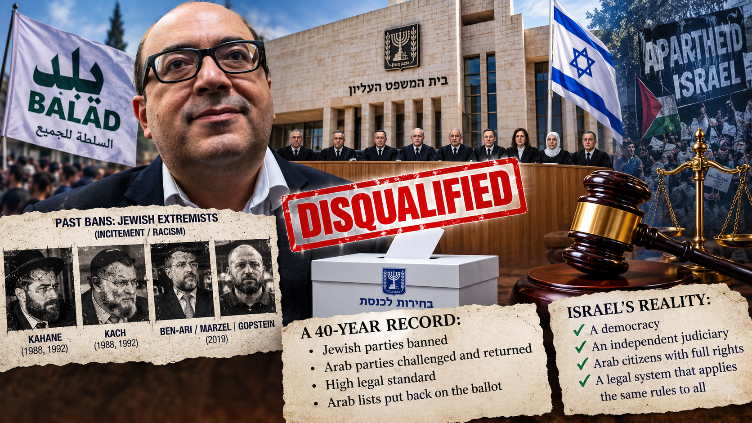 Click Image to Enlarge. Image created via AI.
Israel is one hearing away from doing something it has never done. On Thursday the Supreme Court unanimously told Balad party chairman Sami Abu Shehadeh that a majority of the nine justices would uphold his disqualification from the October 27 election, and urged him to withdraw by Friday. The fact that the Supreme Court justices issued a unanimous decision is remarkable in a country that rarely sees eye to eye on anything. It is made all the more remarkable that the unanimous decision included the Israeli Arab justice as well, whose very presence on the court belies accusations of apartheid and discrimination.
If Abu Shehadeh does not withdraw, the Court will have to issue the ruling. Either way, the head of an Arab party is about to be kept off the Knesset ballot, and the ruling will be sold abroad as proof that Israel is an apartheid state that silences and discriminates against its Arab citizens.
That claim does not survive the record or reality despite what the headlines will say.
The power to bar a political party or a candidate sits in section 7A of Israel’s “Basic Law: The Knesset.” A candidate may be disqualified for negating Israel as a Jewish and democratic state, for incitement to racism, or for supporting armed struggle by a hostile state or a terrorist organization against Israel. The Central Elections Committee votes first. The Supreme Court reviews, and for forty years it has set a high bar. The forbidden aim alleged has to be dominant, clear, and proved.
Under that test, to date the political bans that have been upheld have been bans on Jewish parties and politicians.
With one exception in 1965 before the Basic Law existed, the pattern is uniform. In 1988 the Court upheld the disqualification of Kach, Rabbi Meir Kahane’s party, for incitement to racism. In 1992 it upheld further bans on Kach and another party, Kahane Chai. In 1994, after Baruch Goldstein, a Kach supporter, murdered 29 Arab worshippers at the Cave of the Patriarchs in Hebron, the cabinet outlawed both groups as terrorist organizations. In April 2019 the Court barred Michael Ben-Ari of the Otzma Yehudit party for racism, though the committee had let him run. That September it barred Baruch Marzel and Bentzi Gopstein on the same ground.
Throughout Israeli history all of those banned have been Jewish, and accused of racism or incitement against Arabs. That will not make your headlines or even a sentence buried in the 34th paragraph.
Every attempt to exclude an Arab party or an Arab candidate has failed in court.
The committee tried to bar Balad, and Arab Israeli politicians Azmi Bishara, and Ahmad Tibi in 2003. The Court reversed it. It tried again with parties Balad and Ra’am-Ta’al in 2009. Reversed. Knesset member Haneen Zoabi of Balad was also attempted to be barred in 2013 and 2015. Those were reversed. The Ra’am-Balad party list and Ofer Cassif in April 2019. Reversed. Balad again in 2022. Reversed.
The Israel Democracy Institute’s count through 2020 found that, of the committee disqualifications under the 1985 law, the Court upheld only Kach in 1988 and Kach and Kahane Chai in 1992. The later individual bans were also of Jewish politicians, and the Court imposed them itself. Arab lists that the politicians threw off the ballot were put back on it by the judges.
That is the opposite of a system rigged against Arab citizens, or displaying any semblance of apartheid or discrimination. It is a system that has been stricter with Jewish racists than with Arab nationalists, including a party whose founder – Azmi Bishara – fled Isael for Qatar under investigation on charges of treason for aiding Hezbollah and never came back to face trial.
Abu Shehadeh’s case is the first one that has looked different to the judges, and the reason is not his ethnicity. It is an article he published on October 8, 2023, while the Hamas massacre was still underway, under the title “Al-Aqsa Flood: Initial Observations.” He called the attack an important historical event in the military, political, and strategic sense. He treated it as a successful operation and dwelt on what could be gained from it. He wrote that if small, besieged Gaza could hide its plans from Israeli intelligence and achieve operational surprise, others could do the same more effectively. He addressed “the resistance” as an actor that should bring in the PLO and Arab states, turn the fighting into political gains, and end it with fewer losses. There was no condemnation of the Hamas massacre. Just celebration. A social media post cited in the petition showed three men the petitioners identify as terrorists, with words of respect.
The Central Elections Committee voted 31 to 4 to bar him, on both armed struggle and negation of Israel as a Jewish and democratic state. Justice Noam Sohlberg, the committee chairman, voted with the majority, which chairs almost never do. Attorney General Gali Baharav-Miara, who opposed the wider bans on Arab parties Ra’am and the Joint List, asked the Court to uphold Abu Shehadeh’s disqualification on the armed-struggle ground alone. She called his later explanations partial and unconvincing.
He says the piece was analysis, not support. He says he did not praise the killing of civilians, defend hostage-taking, or call for another attack, and that the practical proposal was a diplomatic track through the Palestinian Authority and Arab states. He says that if he had known the scale of the atrocities he would not have published it, and that he regrets it. His lawyers argue that one article cannot show the repeated, central support for armed struggle that earlier precedents required, and that the state is punishing the absence of a condemnation.
The Court has now signaled that a majority does not accept that defense. Court President Yitzhak Amit told him there is a majority for disqualification and recommended that he withdraw.
None of this will matter to the indictment already being drafted. A ban on the chairman of Balad will be presented as collective punishment of two million Arab citizens of Israel, evidence that the Jewish state cannot tolerate an Arab political voice. Discrimination and apartheid will be used as freely as Hamas’ shooting, burning, raping, and kidnapping on October 7.
The Arab parties still before the Court, Ra’am and the Joint List, will be folded into the same sentence, though the attorney general opposed those bans, and the Court has not decided them. Israel will be branded as an apartheid state no matter how the record disproves that.
The forty-year record will be conveniently left out: Jewish extremists barred and kept out, Arab parties challenged and returned, a legal standard tight enough that Kahane’s heirs were the ones who could not meet it.
If the ruling comes, it will be about one man, one article, and one day in October 2023 that demonstrate how a man elected to Israeli parliament cannot hide behind hateful statements that undermine the very right of Israel to exist as a Jewish state. Calling that apartheid is not a finding. It is a refusal to read the case. It is a lie. But it will be in your headlines all the same. Even the US right of free speech does not allow for someone to yell “fire” in a crowded theater, and should not allow one to celebrate the arsonists trying to burn it all down.


Leave a Reply
You must be logged in to post a comment.