
Harry Libeman
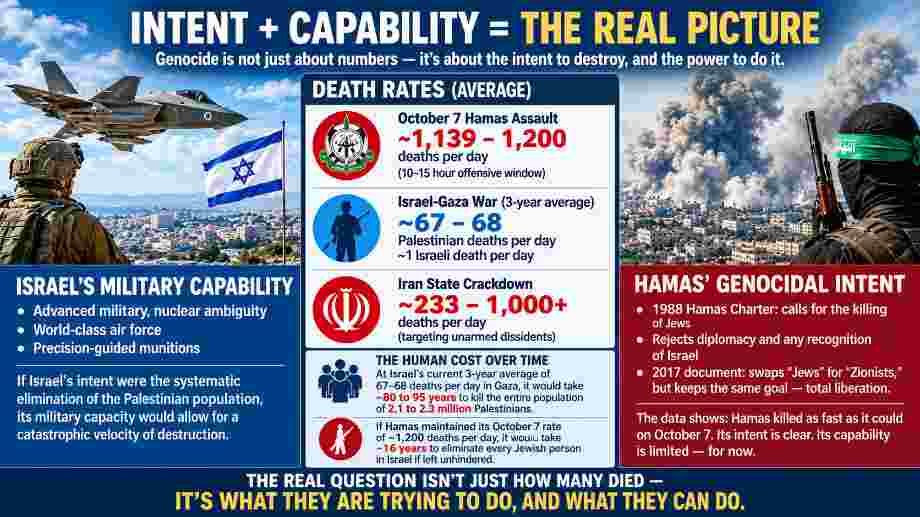 Click Image to Enlarge. Image created via AI.
Under the 1948 Genocide Convention, the ultimate legal threshold for the “crime of crimes” rests on a singular concept: intent to destroy, in whole or in part, a protected group. In modern discourse, critics often look strictly at the raw asymmetry of casualties in the Middle East to level accusations of genocide against Israel. Yet, an objective analysis of military capability, population demographics, and explicit founding doctrines reveals that a group’s ambitions—paired with the arithmetic of violence—tell a completely different story.
When analyzing intent through the lens of capability, the stark contrast between Israel and Hamas becomes irrefutable.
Israel possesses one of the most advanced military apparatuses in the world, equipped with nuclear ambiguity, a world-class air force, and precision-guided munitions. If Israel’s intent were the systematic elimination of the Palestinian population, its military capacity would allow for a catastrophic velocity of destruction.
Instead, the Israel-Gaza War has averaged ~67 to 68 Palestinian deaths per day over a three-year span—a tragic toll of high-intensity urban combat, yet one that represents a fraction of Israel’s actual capacity to inflict harm. Furthermore, despite decades of blockades and recurrent conflict, the population of Gaza has steadily increased in numbers, including its refugee demographic. Genocidal campaigns historically result in the rapid, absolute contraction of a population; a demographic increase directly contradicts the premise of a systematic eradication policy.
To understand what unrestrained, genocidal intent paired with total capability actually looks like, one only needs to examine the internal crackdowns of authoritarian regimes.
During the peak of the Iranian state suppression, the regime’s killing rate reached up to ~1,000+ deaths per day in localized zones, meaning that in a single 24-hour window, the regime slaughtered an amount of its own people equivalent to nearly half of all deaths accumulated in Gaza over three years of conventional warfare.
By contrast, Hamas’s lower efficiency is a reflection of a deficit in capability, not a deficit in intent.
The true, uncompromised ambitions of Hamas are laid bare in its foundational 1988 Hamas Charter. Unlike conventional nationalist struggles that center on border disputes or territorial compromises, the charter explicitly frames the conflict as an existential, religious obligation to eradicate a people. Article 7 of the Hamas Covenant explicitly mandates the killing of Jews, citing theological texts that state the Day of Judgment will not come until “Muslims fight the Jews and kill them.” Article 13 explicitly rejects any diplomatic avenues, stating flatly that “there is no solution for the Palestinian question except through Jihad.” Even when Hamas released its 2017 policy document to soften its public relations image by swapping the word “Jews” for “Zionists,” the group explicitly refused to repeal the original charter, maintained its refusal to recognize Israel, and reaffirmed its goal of total liberation from the river to the sea.
The data points from modern conflicts highlight a vital truth for the Genocide Convention:
- October 7 Hamas Assault: ~1,139 to 1,200 deaths per day, demonstrating maximum lethal efficiency when Hamas faced no immediate military opposition. The calculation reflects the victims murdered or killed during a concentrated 10-to-15-hour offensive window.
- Israel-Gaza War: ~67 to 68 Palestinian deaths per day and ~1 Israeli death per day over a sustained three-year operational theater.
- Iran State Crackdown: ~233 to 1,000+ deaths per day directed entirely at unarmed domestic dissidents.
Based on the long-term averages of the three-year conflict, Israel has killed an average of 67 to 68 Palestinians per day in Gaza, meaning that at this precise operational pace, it would take approximately 80 to 95 years to kill the entire current population of roughly 2.1 to 2.3 million Palestinians.
Conversely, Hamas’s 10-to-15-hour window of maximum operational efficiency demonstrated on October 7, 2023 (averaging ~1,200 deaths per day), Hamas would theoretically require roughly 16 years to eliminate every Jewish person in Israel if left entirely unhindered by military opposition.
When Hamas possessed uncontested operational control on October 7, its per-day killing rate rivaled the world’s bloodiest regimes.
The metrics show that Hamas killed as fast as it physically could, targeted entirely at a specific national group. Under the logic of the Genocide Convention, if a faction’s explicit charter calls for the annihilation of a people, and its per-day killing rate spikes the exact moment it gains the ability to kill, the legal diagnosis is clear. Hamas clearly states its genocidal intent of the Jewish people; it merely lacks the efficiency to finish what its charter started.
The Restraint vs. Rhetoric Divide: Why Capability Defies the Narrative of Genocidal Asymmetry
The core argument challenges mainstream international coverage by asserting a hard, mathematical reality: genocidal intent must be measured by what a group seeks to do with the power it possesses, rather than the raw disparity of a final casualty count. When stripped of political interference, the sheer velocity of the violence on October 7, paired with the state-backed architecture of its sponsors in Iran, points to a unilateral genocidal ambition that is held in check only by Israeli military defense.
Objectively, one must look at the mathematical correlation between military capability and the per-day rate of killing.
This data exposes a fundamental paradox for critics who accuse Israel of genocide.
Israel holds an absolute, undisputed asymmetry in weaponry, air power, and technology. If the state’s intent were the erasure of the Palestinian people, a nation with that degree of lethal capability could execute a toll mirroring or exceeding October 7 every single day. Instead, the multi-year daily average reflects a highly localized, attritional urban conflict against an embedded militant force. The demographic reality that the Palestinian population has expanded over decades, rather than contracted, stands as a fact-based testament to a lack of systematic annihilation policy.
Conversely, the data from October 7 reveals what happens when Hamas achieves even a momentary, 24-hour bypass of Israel’s defensive perimeter. Facing unarmed communities and music festivals, their localized killing rate instantly surged to over 1,100 people in a single day. This was not a war of attrition; it was an unconstrained execution of the 1988 Hamas Charter, which explicitly mandates the hunting and killing of Jews worldwide rather than a simple territorial dispute. The killing on October 7 did not stop because of internal restraint; it stopped solely because the Israel Defense Forces physically recaptured the territory.
Furthermore, the argument that Hamas exists as an isolated militant faction separate from the broader population is increasingly complicated by field data. Independent polling from the Palestinian Center for Policy and Survey Research (PCPSR) consistently tracked significant public alignment with the events of October 7. While support for Hamas as a political governing entity has steadily eroded significantly—dropping to a national low of 19% (with 13% in the West Bank and 27% in Gaza)—the underlying justification for the October 7 “correctness” and a firm 74% opposition to disarming Hamas remains deeply entrenched across both territories.
When a population’s ideological consensus endorses a mass slaughter, and its leadership is directly funded, armed, and directed by an Iranian regime whose stated geopolitical goal is the total erasure of the “Zionist entity,” the legal threshold of the 1948 Genocide Convention is met. The “red-green alliance” of Western progressive groups and authoritarian states frequently uses the lower casualty numbers of Israelis as a political shield to obscure this reality. However, an objective, data-driven analysis yields only one logical conclusion: one side possesses the absolute capability to destroy but exercises structural restraint, while the other side possesses the absolute zeal to destroy and is limited only by its lack of weapons.
Comparative Baseline Caveat (2006–2026)
To contextualize internal vs. external protection under contrasting regimes over the last two decades, the baseline numbers stand as follows:
- Palestinians killed in Gaza by Hamas (2006–2026): ~645 to 715+
- Palestinians killed inside Israel by the IDF (2006–2026): ~450 to 550+ (Note: This strictly includes Palestinian militants from Gaza/the West Bank killed by the IDF inside Israeli territory during cross-border incursions, such as the October 7 assault, alongside localized security incidents involving Arab citizens of Israel).
The verified data mapping these figures can be accessed and cross-referenced through the following primary human rights databases:
Palestinians killed in Gaza by Hamas (~645 to 715+): Complete timelines tracking inter-factional civil fighting, peacetime capital punishment, and wartime extrajudicial executions can be explored via the B’Tselem Database on Palestinians Executed by Hamas. This data is supplemented by historical field reporting from the United Nations Office for the Coordination of Humanitarian Affairs (OCHA) and the Amnesty International Gaza Briefings, which track unreported summary actions and political purges.
Palestinians killed inside Israel by the IDF (~450 to 550+): Detailed incident logs identifying cross-border combatants, neutralized attackers, and security-related fatalities occurring within Israel’s pre-1967 borders can be evaluated using the B’Tselem Fatalities Interactive Map and Database as well as data verified under the OCHA Protection of Civilians Framework.
Israpundit is entirely dependent on readers support. Please help me continue educating people with the truth about what is going on in Israel and around the world.


Leave a Reply
You must be logged in to post a comment.