
Peloni: As the US is positioning itself to pivot to Asia, its stated position is to rely more heavily on allies capable of not only defending themselves, but promoting US interests on America’s behalf. So far, there has been scant evidence that Trump’s Gulf allies, for all the deference and promotion he has allowed them, has any intention of filling the role described above. In fact, the Saudi participation in the recent strike in Iraq was notably accompanied by the accompanied statement from Riyadh indicating that MBS is still calling for an end to the war, much as explained by Hussain Abdul-Hussain below. In fact, of all of Trump’s allies, only Israel has demonstrated both the will and capacity to succinctly work with Washington to achieve the objectives of pursuing joint interests, and for Trump’s pursuit of an Asia pivot, this void of support which only Israel has filled in any meaningful way, is a demonstration of Washington’s other global allies showing greater deference for Chinese interests, which leave Washington trapped in the Middle East, than US interests. Of course, the compliment to recognizing this is whether we really want the Gulf states asserting themselves beyond their borders…
By Hussain Abdul-Hussain | NYP | Published July 30, 2026
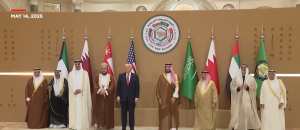 President Trump joined GCC Leaders Summit “family photo” in Riyadh, Saudi Arabia, May 14, 2025. Screengrab via Youtube.
President Donald Trump says he has “plenty of time” for talks with Iran.
That works because Washington, DC, is 7,000 miles away from the Strait of Hormuz. But if you are in Dubai, the distance drops down to less than 50 miles.
While America can afford a protracted war far from its borders to degrade Iran’s military capabilities, such low-intensity confrontation comes at a high cost for the six Gulf Arab nations.
Iranian strikes on civilian infrastructure like airports and power plants along with the uncertain fate of oil exported through the Strait of Hormuz has had a devastating economic impact.
For the Gulf countries, this war cannot end too soon.
If America wants to twist Iran’s arm to force it to concede, therefore, then Washington must apply greater military force.
The last thing Gulf countries want to live through is the current on-again, off-again war.
For Gulf economies to rebound, American consistency, which is in short supply these days, is a necessary condition.
Throughout the war that began at the end of February, these countries have been on the receiving end of sustained Iranian attacks.
Unlike Israel, the US’s partner in the first phase of the war, the Gulf states don’t possess the will or the means to join the fight.
Must the United States then curb its bombing of Iran so Tehran’s immediate neighbors are spared from its wrath?
And if not, can Washington do anything to provide them with more protection?
Nearly six months into a war that all six Gulf states initially opposed, Iran’s attacks have left them in no doubt that the regime poses the most direct and deadliest threat to their security.
That realization hasn’t resulted in a unified Gulf policy toward Iran.
Some states are more hawkish than others.
But the economic strain brought about by the war, by Iran’s blockade of the Strait of Hormuz, and now by the growing tensions in the broader Red Sea, has forced all of them to conclude that the current situation of “no war, no peace” isn’t tenable.
Among the hawks, the United Arab Emirates stands out as the most strident voice.
After the Iranians pounded Abu Dhabi with ballistic missiles, the UAE broke diplomatic ties with Iran, deported Iranian expatriates and froze Iranian bank accounts.
Bahrain — which hosts the US Fifth Fleet and US Naval Forces Central Command — is also a staunch opponent of Tehran.
During the recent fighting, Iranian forces attacked civilian and military installations in Bahrain. Bahrain struck Iranian targets in response.
Nor have the remaining Gulf countries, which tend toward neutrality and have historically had good relations with Iran, been spared.
Iran pulled Kuwait into the fray by targeting its main international airport, along with desalination plants, power stations and offshore oil rigs.
When it comes to Qatar and Oman, both have continued to appease the mullahs despite attacks on their soil by Tehran.
Saudi Arabia has adopted a similarly non-confrontational posture, although it joined in US attacks on Iranian-linked sites in Iraq this week after they targeted US forces.
As the US administration deliberates on the next steps in the war, it will need to take into account these different positions, given our close commercial and military ties in the Gulf.
None of these countries is likely to oppose a further US military offensive outright, particularly if it ends Iran’s stranglehold on the passage of oil.
Conversely, a US pullback will send a signal to Tehran that it is the main power in that region, to the detriment of our Gulf Arab allies.
To be blunt, there is no way of preventing Iran from retaliating against the Gulf states.
The question, therefore, is how much more pain these states are prepared to absorb.
As long as the Islamic Republic remains a threat, the Gulf States have to choose between appeasement, which will cement Iran as the dominant power in the region, containment, which means relying on a United States that is wary of indefinite commitments, or confrontation, which will require them to step up their own defense and even acquire nuclear weapons.
A better option is to resolve the problem now by urging Trump to follow through on his latest warnings to Iran’s rulers.
Because whether they like it or not, as long as the regime survives, ultimately all the Gulf states are at risk.
Hussain Abdul-Hussain is a research fellow at the Foundation for the Defense of Democracies.


Leave a Reply
You must be logged in to post a comment.