
By Walter E. Block and Oded J.K. Faran
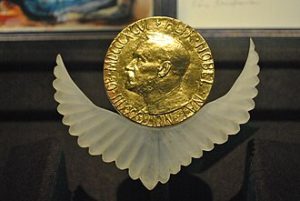 Nobel Peace Prize. By ProtoplasmaKid – Own work, CC BY-SA 4.0, Wikipedia
The argument we wish to make has two distinct parts, and they point in different directions. The first establishes that Donald Trump has earned the Nobel Peace Prize by any fair reckoning of the criteria Alfred Nobel himself laid down. The second argues that, if the prize is eventually offered, Trump should refuse it. Both propositions can be true simultaneously, and understanding why they can be, reconciles the apparent paradox in the title above.
I. The Case for Trump’s Worthiness
Alfred Nobel’s will stipulated the prize should go to the person who “shall have done the most or the best work for fraternity between nations, for the abolition or reduction of standing armies and for the holding and promotion of peace congresses.” By that standard, the record of the Trump administration from 2025 onward is, whatever one thinks of its domestic politics, historically remarkable.
The White House has claimed credit for brokering ceasefire frameworks or diplomatic declarations between no fewer than eight pairs of belligerents: Azerbaijan and Armenia, Cambodia and Thailand, Israel and Iran, Rwanda and the Democratic Republic of Congo, India and Pakistan, Egypt and Ethiopia, Serbia and Kosovo, and Israel and Hamas. Honest critics correctly note that several of these agreements lack binding enforcement mechanisms, that fighting has continued in some theaters after the signing ceremonies, and that the DRC-Rwanda accord in particular built upon prior regional negotiations rather than originating with Washington. These are valid qualifications. But the consistent pattern of active American diplomatic engagement, the concrete signing ceremonies, and the measurable reduction in hostilities in several of these cases represent a body of work that no honest observer can simply dismiss.
Then there is the Abraham Accords framework, which represents the most durable and structurally significant diplomatic achievement. Announced in August and September 2020 and signed in Washington, the Accords normalized relations between Israel and the United Arab Emirates, Bahrain, Morocco, and Sudan, constituting the first formal Arab-Israeli normalization since Jordan’s peace treaty in 1994. The second Trump administration has continued expanding the framework: Kazakhstan formally acceded in November 2025, and discussions with Saudi Arabia, Syria, and Lebanon remain ongoing. Critics rightly observe that these agreements sidestepped rather than resolved the Palestinian question, and that Arab public opinion in many signatory countries remains skeptical. But as diplomatic architecture, the Accords are real. They created embassies, trade relationships, security cooperation, and cultural exchange that did not exist before.
Compare this record to some recent Nobel laureates. Barack Obama received the prize in 2009 after fewer than nine months in office, with nominations closing just eleven days after his inauguration. The Norwegian Nobel Committee’s own former secretary, Geir Lundestad, later publicly admitted regret over the decision, acknowledging it did not yield the results the committee had hoped for and that Obama himself was surprised by the announcement. Abiy Ahmed won in 2019 for ending the conflict between Ethiopia and Eritrea, only to preside over the catastrophic Tigray War within a year of the ceremony. The 2021 prize went to two journalists for defending press freedom, a worthy cause but one that stretches “fraternity between nations” and the “abolition of standing armies” considerably. Against this backdrop, Trump’s tangible, if imperfect, diplomatic record stands out.
II. The Case for Refusing the Prize
If Trump deserves the prize, why should he decline it? For two reasons, one institutional and one philosophical.
The institutional reason is that the Nobel Peace Prize has become an instrument of the progressive Norwegian political establishment rather than an impartial arbiter of the criteria Nobel set down. The Norwegian Nobel Committee is appointed by the Storting, the Norwegian parliament, to reflect the party composition of that body. It does not pretend to be a neutral, technocratic panel. Its repeated choices over the past two decades, including the Obama award widely interpreted across the political spectrum as a symbolic rebuke of the George W. Bush administration, have made the political valence of its deliberations unmistakable. The committee’s apparent reluctance to recognize Trump’s record, despite achievements that, measured by Nobel’s own criteria, compare favorably with recent honorees, speaks for itself. A prize awarded by such a body, when and if offered, carries the implicit message that the recipient has become acceptable to a particular ideological coterie. Trump, whatever his faults, need not seek that validation.
The philosophical reason runs deeper and requires a more careful argument. Peace, understood simply as the absence of armed conflict, is not an unconditional good. This is not a provocative or eccentric claim; it is in fact the position Obama himself gestured toward in his Nobel acceptance speech when he discussed the concept of a “just war.” But the point deserves to be pressed further than Obama took it.
To Be Continued in Part 2 Next Sunday
Sources
White House Press Release, “President Trump Brokers Another Historic Peace Deal” (August 8, 2025). https://www.whitehouse.gov/articles/2025/08/president-trump-brokers-another-historic-peace-deal/
Jake Horton and Nick Beake, “How Many Wars Has President Trump Really Ended?” BBC Verify (October 15, 2025). https://www.bbc.com/news/articles/c5y3599gx4qo
Peter J. Quaranto and George A. Lopez, “A Closer Look at Trump’s Peace Deals,” Just Security (October 10, 2025). https://www.justsecurity.org/122215/closer-look-trump-peace-deals/
Abraham Accords, Wikipedia (updated 2026). https://en.wikipedia.org/wiki/Abraham_Accords
Abraham Accords official documentation, United States Department of State (2020-2021). https://2017-2021.state.gov/the-abraham-accords/
“Abraham Accords After Gaza: A Change of Context,” Carnegie Endowment for International Peace (December 4, 2025). https://carnegieendowment.org/research/2025/04/the-abraham-accords-after-gaza-a-change-of-context
Middle East Institute, “The Abraham Accords” (November 2025). https://mei.edu/publication/abraham-accords/
Nobel Peace Prize Laureates List, NobelPrize.org. https://www.nobelpeaceprize.org/laureates/
“2009 Nobel Peace Prize,” Wikipedia. https://en.wikipedia.org/wiki/2009_Nobel_Peace_Prize
Geir Lundestad as cited in retrospective accounts of the 2009 Nobel Committee’s later regret: see Nobel Peace Prize Wikipedia entry and contemporaneous press analysis.
Alfred Nobel’s Will (1895), Nobel Prize Foundation.
George Orwell, Nineteen Eighty-Four (London: Secker and Warburg, 1949).
Nobel Peace Prize 2025 Announcement: Maria Corina Machado, NobelPeacePrize.org. https://www.nobelpeaceprize.org/


Of course he should turn it down.
He should not wish to be in the company of disgusting people like Arafat and Obama.
I would recommend that Trump accept the Nobel Peace Prize and donate it to a deserving institute that will make the kind of use of it that we would expect for a peace prize. By doing so, he makes sure that the prize, which he does not need, will go to the advantage of people in need who will not get that help anywhere else.