
Peloni: Washington should use its leverage to force Jordan to eliminate all presence and support for the Muslim Brotherhood and their Islamist allies. They should force Jordan to adopt an outright hostile posture to the Iranians. They should force Jordan to support and coordinate with Israel and end its endless blood libels and calls for violence against Israel. And they should demand that the butcheress Tamimi is finally handed over to face American justice. Washington has the influence to do all of this. The question is whether they will do any of it.
Ahmad Sharawi & Behnam Ben Taleblu | June 12, 2026
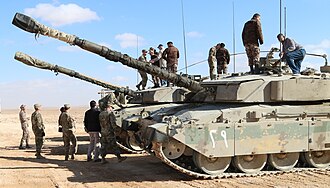 1AD tankers train with Jordanian Armed Forces. Photo by Sgt. 1st Class Kenneth Upsall – dvidshub.net, Public Domain, Wikipedia
The Jordanian Armed Forces (JAF) announced on June 11 that they had intercepted 20 missiles launched from Iran toward Al-Azraq, a town about 50 miles east of Amman that is also home to a major air base used by U.S. forces.
Though the announcement came from the JAF, Jordan does not have advanced missile defenses. American forces, who are co-located on the base, likely intercepted the strikes with their own systems. Open-source analysis and Iranian semi-official media have shared imagery and video of missile impact and warheads making it past air defenses. This imagery highlights Jordan’s vulnerabilities to future Iranian missile launches.
The latest attack marked the second direct Iranian strike on Jordan since the April ceasefire between Iran, the United States, and Israel, following strikes on June 10. Previously, Jordan was struck by 166 ballistic missiles and 125 drones launched by Iran and its proxy militias in Iraq in response to the combined U.S.-Israeli strikes on the Tehran regime between February 28 and April 8.
The attack reflects Iran’s strategy of punishing regional states that host American military forces, with the goal of driving the United States out of the region.
Iran’s Strategy Toward U.S. Regional Partners Intersects With Anti-Americanism
The Islamic Republic has long sought to military and diplomatically evict the United States from the Middle East. Traditionally, this was done through support for terrorist proxies that Tehran created or co-opted as part of a larger strategy of exporting its Islamic Revolution. These nonstate actors would apply asymmetric military pressure against states perceived to be part of the pro-American regional order. This approach has allowed Iran to prosecute its revisionist agenda below the threshold for outright war while increasing the costs of alignment between each state and the United States.
But increasing Iranian risk tolerance, along with a significant improvement in the regime’s long-range strike capabilities, is providing Iran with a pathway to use more overt force to target regional rivals and impose costs on them for their pro-Western orientation. Tehran’s preferred method has been to frame attacks on these states as attacks limited to military facilities that the United States used to strike Iran.
Jordan’s Evolving Response to Iran
Jordan has traditionally adopted a cautious approach toward the Islamic Republic, seeking to avoid the sort of direct confrontation or entanglement with Iran that Iraq and Gulf Cooperation Council countries have been subjected to over the past four decades. Amman is also wary of provoking Iranian retaliation in the event of a U.S.-Iran conflict and sensitive to perceptions of cooperation with Jerusalem and Washington against Tehran given the potential domestic backlash.
A few weeks before the war, Jordanian Foreign Minister Ayman al-Safadi told his Iranian counterpart, Abbas Araghchi, that “Jordan will not be a battlefield for any party in any regional conflict.” Yet after becoming a direct target of Iranian missiles and drones, Jordan’s public posture shifted.
Throughout the war, Jordanian officials emphasized that the kingdom was being directly targeted by Iran. Military officials argued that despite Jordan informing all “concerned parties” that it would not serve as “a battleground for anyone,” the country was not spared from Iranian assault. Jordan has also avoided framing the strikes as attacks on the U.S. presence in the country, instead portraying them as violations of Jordanian sovereignty. Amman then embraced diplomatic pressure on Tehran, with Safadi revealing that Jordan refused to extend the residency of one Iranian diplomat and denied accreditation to another.
However, some parliamentarians diverged from the official line. One member of parliament, Ismail Mashagbeh, argued that Jordan should not intercept missiles over its airspace.
Washington Should Help Jordan Hold the Line Against Iran
In 2022, Washington and Amman signed a seven-year, nonbinding memorandum of understanding under which the United States committed to requesting at least $1.45 billion annually in assistance for Jordan.
Using this agreement as a basis, Washington should strengthen Amman’s partnership with Jerusalem in efforts to counter Tehran, expand intelligence sharing, and facilitate Jordan’s deeper integration into the U.S.-led regional air and missile defense architecture to help Amman detect and destroy Iranian projectiles.
Ahmad Sharawi is a senior research analyst at the Foundation for Defense of Democracies (FDD), focusing on Iranian intervention in Arab affairs and the Levant. Behnam Ben Taleblu is the Iran Program senior director and a senior fellow. For more analysis from the authors, please subscribe HERE. Follow FDD on X @FDD. Follow Ahmad on X @AhmadA_Sharawi and Behnam @therealBehnamBT. FDD is a Washington, DC-based, nonpartisan research institute focusing on foreign policy and national security.


Leave a Reply
You must be logged in to post a comment.