
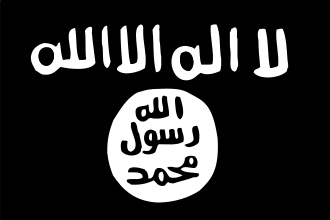
 Flag of the Islamic State (IS), also known as “Islamic State of Iraq and Syria” (ISIS) or “Islamic State of Iraq and the Levant” (ISIL). Photo by Yo – Own work, Public Domain, Wikipedia
After surviving numerous Islamic State (ISIS)-linked assassination plots, Syria’s President Ahmad al-Sharaa — himself a former jihadi — governs with a target on his back. Moreover, ISIS is resurging in Syria at precisely the moment that the United States is scaling back its military presence.
?According to a report from United Nations’s Analytical Support and Sanctions Monitoring Team issued on February 11, “In 2025, five assassination attempts were foiled against the President [of Syria], the Minister of Interior [Anas Khattab] and the Minister for Foreign Affairs [Asaad al-Shaybani].” The report alleges that Sharaa was targeted by Saraya Ansar al-Sunnah, a group assessed to be an ISIS front.
ISIS is exploiting Syria’s instability and sectarian fault lines to regroup, rearm, and plan further attacks against both the country’s leaders and already vulnerable minorities. Concerningly, these efforts come as the United States begins to draw down its limited but effective military presence in Syria.
A full U.S. withdrawal now would risk reversing a decade of counterterrorism gains that significantly degraded ISIS’s capabilities. Tensions between Damascus and the U.S.-backed, Kurdish-led Syrian Democratic Forces (SDF) may well spark renewed clashes that could quickly fracture security in northeastern Syria, where ISIS remains active.
ISIS Growing Its Arsenal
While ISIS is only one of several forces destabilizing Syria, its reconstitution poses the most direct threat to U.S. interests. According to the UN report, the group exploited the chaos following Assad’s fall to acquire “anti-tank missiles, artillery, anti-aircraft systems, and mortars.” Its ranks are also growing, assessed to include approximately 3,000 active fighters.
?The group’s objective in Syria is to win recruits and expand its terrorist activities. It does this by targeting minority communities in order to deepen the distrust between the state and the country’s ethnic/religious minorities.
Last December’s bombing of a mosque in the city of Homs that served the Alawite minority, as well as the earlier bombing in June of the Greek Orthodox Mar Elias church in Damascus, graphically illustrate this strategy. In tandem, ISIS seeks to penetrate Syria’s weak security apparatus by exploiting the many officers and fighters who harbor radical Islamist sympathies.
?Sharaa Government is an Unreliable Counter-Terrorism Partner
The U.S. withdrawal from Syria reflects a misguided confidence that Damascus can serve as a capable long-term counterterrorism partner against ISIS and other jihadist groups. While the authorities have reportedly arrested at least 278 ISIS operatives, disrupted 45 planned attacks, and dismantled 23 terrorist cells, these tactical successes are undermined by the structural vulnerabilities within Syria’s security apparatus
Syria’s security forces still include thousands of former jihadists, many of whom remain ideologically radical and potentially vulnerable to ISIS influence. More troubling still, the government has struggled to impose effective command and control over elements within its own ranks. The December 2025 terrorist attack in which two U.S. servicemembers and a civilian interpreter were killed drew an acknowledgement from the authorities that the perpetrator, a member of the security forces, was already known to hold “extremist ideas” — raising the obvious question as to why such an individual was operating in close proximity to American personnel.
The U.S. Needs To Retain a Visible Military Presence in Syria
The U.S. decision to withdraw from the al-Tanf base in northeastern Syria is a consequential shift in America’s posture in Syria, even as hundreds of U.S. troops remain deployed elsewhere in the country. The force drawdown signals diminished commitment at a time when ISIS is actively probing for opportunities to reemerge.
America’s small but effective footprint provides the intelligence, surveillance, and strike capabilities that prevent the group’s reconstitution. Washington should review its confidence in Sharaa’s forces as counterterrorism partners, especially given how quickly that trust was extended.
The immediate priority must be preventing renewed Damascus-SDF clashes, which ISIS is poised to exploit. Properly integrating the SDF into state military structures could help counterbalance radical elements that remain within the Syrian army. Additionally, a durable plan for managing ISIS detention camps in northeastern Syria is key to preventing mass escapes by terrorists.
Ahmad Sharawi?is a senior research analyst at the Foundation for Defense of Democracies (FDD). For more analysis from Ahmad and FDD, please subscribe?HERE. Follow Ahmad on X?@AhmadA_Sharawi. Follow FDD on X?@FDD. FDD is a Washington, DC-based, nonpartisan research institute focusing on national security and foreign policy.


I googled: “Was the first Amendment crafted to protect political satire?”
“AI Overview
+8
The First Amendment was not crafted to protect only satire. Rather, the Founders drafted it to protect all political dissent, with satire inherently shielded as a vital tool for checking authority. [1, 2, 3]
Why Satire and Parody Are Protected
The Constitution shields this form of expression for several foundational reasons:
* Speaking Truth to Power: Satire is a historical, non-violent mechanism to mock, question, and criticize government officials and institutions without fear of reprisal.
* Preventing Tyranny: The Founders recognized that the ability to criticize the government is the dividing line between a free society and tyranny.
* Testing Reality: The Supreme Court affirmed in the landmark case Hustler v. Falwell (1988) that parody and satire are protected speech—even when intended to cause severe emotional distress—because robust public debate requires the freedom to offend and mock public figures. [1, 2, 3, 4]
The Historical Context
While the First Amendment protects it now, the Founders’ relationship with satire was complicated. During the colonial era, newspapers and pamphlets frequently used biting satire and political cartoons to mock the British Crown. [1, 2, 3]
However, shortly after the Constitution was ratified, the young U.S. government passed the Alien and Sedition Acts of 1798, which made it a federal crime to print “false, scandalous, and malicious” writing against the government. While not exclusively aimed at satire, this law was heavily used to silence critics. This tension eventually subsided, and Thomas Jefferson later pardoned those convicted under the acts, re-establishing the nation’s commitment to free expression. [1, 2]
Today, American jurisprudence (including sites like the Free Speech Center) firmly establishes that the freedom to mock societal and political norms is a core element of the First Amendment. [1, 2]”
https://www.bbc.com/news/articles/c874nw4g2zzo
https://m.facebook.com/story.php?story_fbid=pfbid035AFbyRDv81eF4qzFqdpJmXhYmWCyWVNvLFi1EsJPi2Msfpfef6uGDehUiRHFh7Kbl&id=100044226919507
FB claims that this is fake news based on a poster claiming it is and that sharing this is a violation of their community standards. Do I Agree?
No. The Mamdani part is obviously satire. The rest is factual and verified by the BBC which hates Trump so much they, by their own admission doctored their footage of his speech on January 6 to frame him but brazenly refused to pay compensation.