
Peloni: Jolani, Jolani, Jolani…what should we have expected when a lifelong Islamist was installed to govern over the diverse population in Syrian society? I think we should have expected exactly what we have received, and that is a cruel fate for the minorities of Syria, particularly those who will not submit to the Islamization process taking place in Syria today under Jolani’s tender care.
O. Peri | MEMRI | June 6, 2026
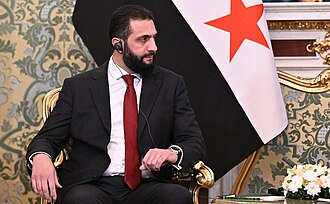 Abu Muhammad al-Jolani. Photo by Kremlin.ru, CC BY 4.0, Wikipedia
The new Syrian regime, headed by President Ahmad Al-Sharaa – formerly the leader of the Islamist organization Hay’at Tahrir Al-Sham (HTS)[1] – is promoting religious radicalization and Islamization in Syria, despite its public statements about commitment to the rule of law, pluralism, and civil equality, and although it enjoys considerable foreign support, including from the U.S. and other Western countries. Since coming to power in December in 2024 following the overthrow of Bashar Al-Assad’s regime, Al-Sharaa and other regime officials have taken care to issue assurances that the new Syria will not be governed by a single ideology and that all sects and groups will be represented in the regime.[2] During his visit to London on March 31, 2026, Al-Sharaa even stated explicitly that he did not intend to impose strict Islamic rule.[3]
But in practice, the reality on the ground is entirely different: there is a clear and ongoing effort to strengthen Syria’s Islamic character in various domains, in line with the ideological orientation of HTS. Under the cover of tolerant statements, the regime is promoting conservative religious norms, including a restrictive dress code for women and bans on the sale of alcohol in certain places. Alongside this government policy, expressions of religious extremism in the public sphere are increasing as well, at the initiative of Islamist activists and sometimes with the involvement of the security forces. Inciting rhetoric on religious, ethnic, and ideological grounds is heard in many mosques. In addition, Syrian women are experiencing an erosion of their status and freedoms, and are forced to contend with the defacement of their images in public spaces and with the promotion of gender segregation. Bans have occasionally been imposed on playing music or on mixed-gender dancing. The spread of extremism is also evident in public events, such as the Damascus International Book Fair, held in February 2026, where books containing extremist content were sold. These included the works of Ibn Taymiyyah, a medieval Sunni Muslim jurist regarded as a key religious authority by the Salafi-jihadist movement, as well as a book by former Al-Qaeda leader Abu Mus’ab Al-Zarqawi.
Furthermore, the Islamization under Al-Sharaa’s regime is evident in the Syrian education system. This includes gender segregation in some schools, starting in the lowest grades; the removal of scientific content from curricula, and the introduction of extremist content portraying jihadists and leaders of terrorist organizations as “heroes.”
In the Syrian armed forces as well, now being rebuilt mainly from members of Islamist factions, emphasis is being placed on strengthening the soldiers’ Islamic identity.
This report examines the Islamization and religious radicalization in Syria under the Al-Sharaa regime, as reflected in government policy, the education system, the military, and the public sphere.
Establishing The Country’s Islamic Character: Government Policy Reflected In The Public Sphere
Regime Measures Enhancing Islamization: Dress Restrictions And Alcohol Bans
The considerable importance attached by the Al-Sharaa regime to strengthening Syria’s Islamic character is reflected in direct measures taken by government officials and ministries and by local authorities. As part of this, in March 2025 President Al-Sharaa established a Supreme Fatwa Council. One of the council members, Sheikh Na’im Arqasousi, stated that its role would not be limited to answering religious legal questions but would also include correcting administrative and legal decisions by Syrian ministers and other senior officials that contradict shari’a law.[4]
Furthermore, government ministries and local authorities have been advancing directives with a distinctly religious bent. In an effort to obscure this Islamization of society, the regime often presents such measures as reflecting “respect for customs and traditions” or for the country’s “social and religious diversity.” For example, in June 2025, Syria’s Tourism Ministry issued guidelines for conduct at public beaches and swimming pools, stipulating that, “out of respect for the cultural, social, and religious diversity” in Syria, women should wear modest swimwear that covers the body, such as a burkini, while men should wear shirts when not swimming. Citizens were also urged to avoid wearing sheer or very tight clothing.[5]
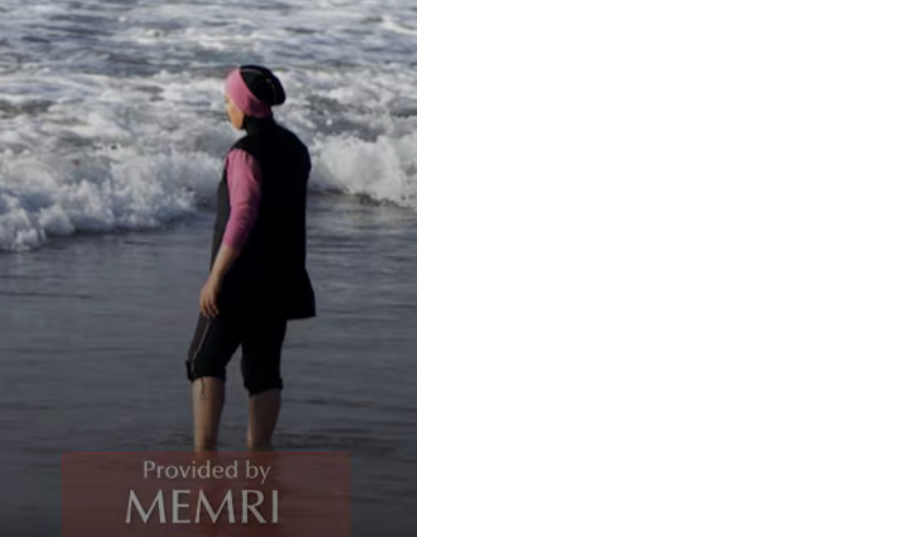 Woman wearing a burkini (Facebook.com/almashhadmedia, June 10, 2026) Image via MEMRI.org
Similarly, in May 2025 the Director of Religious Endowments in Damascus, Samer Bayraqdar, issued a circular to mosque preachers in the city requesting that, ahead of the summer months, they emphasize the need for men and women to dress modestly in consideration of moral norms and the tenets of Islam.[6]
Additional examples include the March 15, 2026 decision by the Damascus Province to prohibit the sale of alcoholic beverages in the capital’s restaurants and nightclubs and to restrict alcohol sales to three Christian areas in the city.[7] Likewise, on April 8, 2026, the municipal council of Ain Manin in the Rif Dimashq Governorate issued a series of directives intended to “regulate social life in the town.” These included bans or restrictions on the sale or public consumption of alcohol, bans on nightclubs, and enforcing modest dress codes.[8] In addition, in January 2026 the governor of Latakia instructed women in the civil service to avoid wearing makeup in the workplace.[9] In May 2026, the municipal council in the town of Badda in this governorate decided to prohibit men – including the groom, his relatives, or the bride’s male relatives – from mixing with women in wedding celebrations, “in adherence to the principles of our religion.”[10]
Radicalization In The Public Sphere: Harassment Of Partygoers, Oppression Of Women, And Weapons Training For Children
This regime policy has filtered down, and is reflected in the conduct of security personnel and Islamist activists who function as a kind of informal religious police, enforcing Islamic standards in the public sphere. According to reports, Syrian security personnel frequently question people at checkpoints about their religion and sect, or stop men and women walking together in the streets to investigate the nature of their relationship. [11] Moreover, on several occasions security personnel or other armed individuals have raided nightclubs and assaulted the patrons. In one raid, on the Al-Karawan nightclub in Damascus, a dancer was killed by gunfire. Footage from another raid, also in Damascus, showed partygoers – particularly women – being beaten as they tried to flee the club.[12] Raids were also carried out on weddings in order to stop the playing of music and demand that the celebrants adhere to Islamic norms.[13]
Extremism was strongly felt during Ramadan this year. The Latakia Governorate closed several restaurants and bars during this month under the pretext that they were serving alcoholic beverages during the fast.[14] In addition, several individuals were arrested on charges of violating the fast.[15]
Women in Syria have been particularly affected by these restrictions. In various areas, there were public campaigns encouraging women to cover their heads, alongside attempts to promote gender segregation in certain institutions and on public transportation. There have also been repeated reports of the defacing of women’s images in public spaces. Furthermore, women’s representation in senior public positions remains very limited.[16]
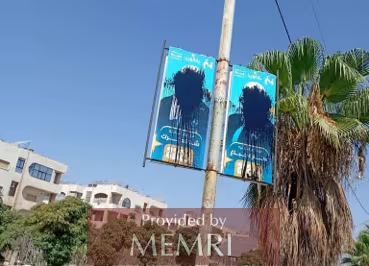 Woman’s portrait defaced in the city of Hama (facebook.com/abonaboot.huda, September 24, 2025) Image via MEMRI.org
The Syrian public has also been exposed to incitement and religious extremism in mosques, where preachers have spoken out against secularists and non-Sunni groups,[17] and in some cases have even incited armed violence. For example, a preacher at a mosque in the Al-Qusour neighborhood of Hama delivered a sermon while holding a gun and called on worshippers not to lay down their arms in the fight against the infidels.[18] In addition, a post (which was later removed) on the Facebook page of Al-Qadam Al-Kabir Mosque in Damascus showed children in military uniform inside the mosque, with the caption “We ask Allah… that Jerusalem be conquered by them.” The image was accompanied by part of a Quranic verse that calls for constant military preparedness: “And prepare against them whatever you are able of power and of steeds of war by which you may terrify the enemy of Allah and your enemy (Quran 8:60).”[19] In another case, during a lecture at a mosque in Hama Governorate, Sheikh Abd Al-Nasser Alwan, head of the Hama Shari’a Council, called to provide people with weapons training. Photos later published from such training sessions showed Alwan alongside armed minors.[20]
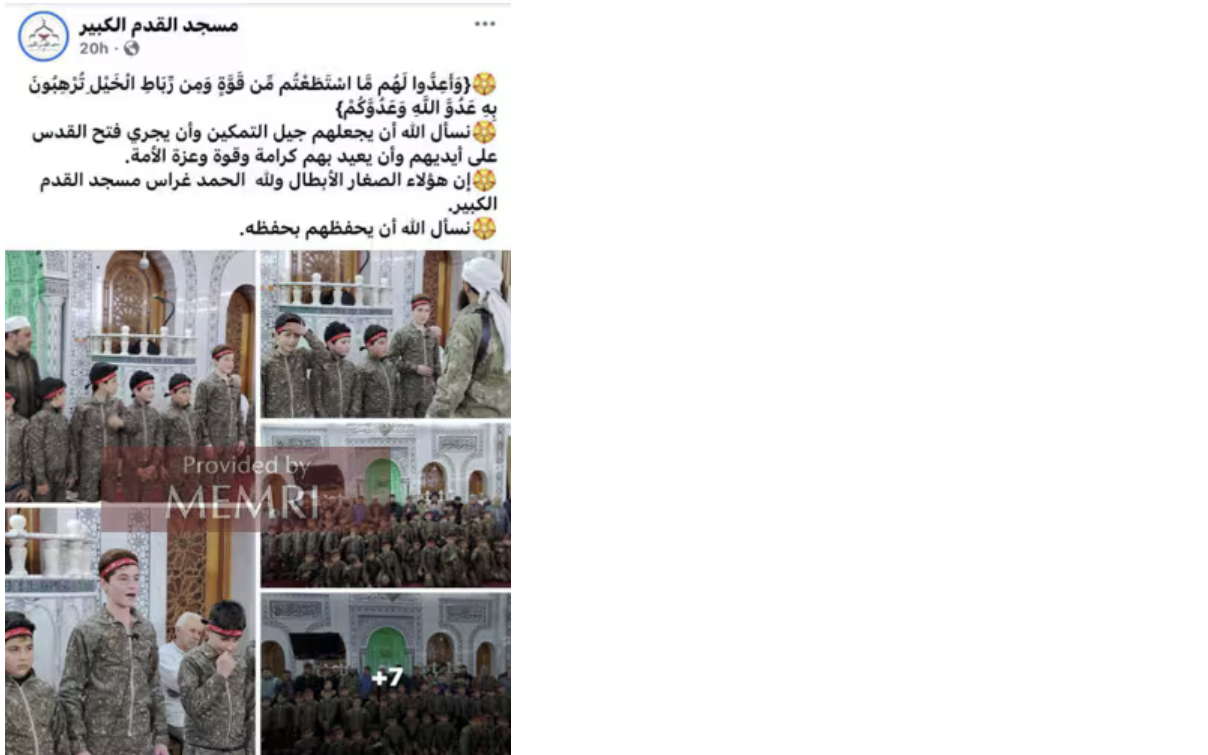 Children in military uniform at Al-Qadam Al-Kabir Mosque in Damascus (Facebook.com/naser.al.naser.860283, March 16, 2026) Image via MEMRI.org
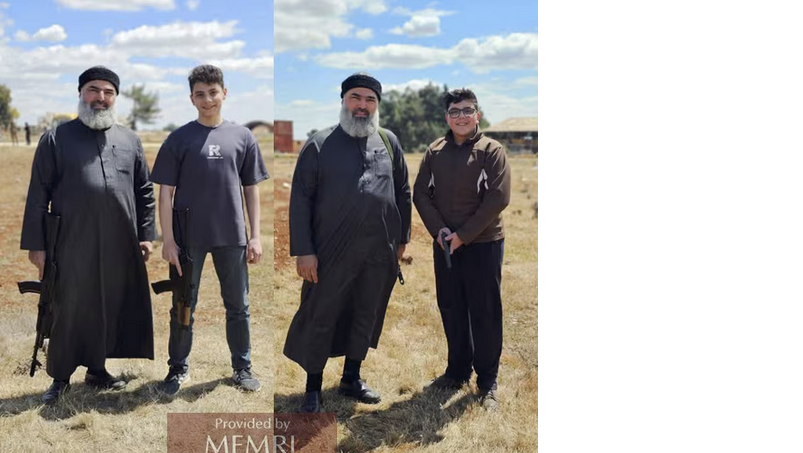 Sheikh Abd Al-Nasser Alwan with armed teens (Facebook.com/groups/1969129190079850, April 19, 2025) Image via MEMRI.org
Expressions of extremism in Syria were also evident at the Damascus International Book Fair, held between February 5–16, 2026, for the first time under Al-Sharaa’s rule. According to reports, Salafi elements distributed leaflets inside and outside the exhibition halls, and more than one hundred Salafi publishing houses participated in the fair.[21] In addition, a booth was dedicated entirely to the works of Ibn Taymiyyah, a medieval Sunni Islamic jurist whose teachings are a major source of inspiration for the Salafi-jihadist movement.[22] Another booth at the fair was hosted by the Doha-based International Union of Muslim Scholars (IUMS), an arm of the Qatari regime that serves to promote an extremist, anti-Western, and antisemitic Islamist ideology.[23]
Additionally, for the first time, the fair presented the memoir of Sheikh Mahfouz Ould Al-Walid (aka Abu Hafs Al-Mauritani), who was a mufti in the Sunni Islamist terrorist organization Al-Qaeda.[24] Another book originally intended for display was a collection of speeches Abu Mus’ab Al-Zarqawi, commander of Al-Qaeda in Iraq, about the Shi’ites, which are referred to by the derogatory term al-rafidah. The book, which discussed their “beliefs, crimes, betrayal, and role in betraying Islam and Muslims throughout history,” [25] was ultimately banned from the fair by the Al-Sharaa regime following a request from Iraqi intelligence, which argued that it incites hatred and sectarianism and must be removed to avoid promoting extremism, particularly at a time when the Iraqi government is seeking to strengthen its relations with Syria.[26]
Radicalization In The Education System: Removal Of Scientific Content And Introduction Of Extremist Narratives Glorifying Jihadists
The promotion of extremist ideology in the Syrian education system was among the first steps taken by the Al-Sharaa regime after it seized power. A document published by the Education Ministry on January 1, 2025, less than a month after the advent of the new regime, outlined changes to curricula and textbooks. These included the removal of scientific content on the theory of evolution, as well as images of statues and deities, and female figures. [27] This document indicated the direction in which Syria is currently heading.
In addition, schools in several Syrian governorates introduced gender segregation, starting in the lowest grades. Although the Education Ministry has denied requiring this, several school principals admitted that the measure had been informally imposed on them.[28]
A key educational institution that works to strengthen the religious identity of the younger generation in Syria, and whose status has grown following Al-Sharaa’s rise to power, is the Dar Al-Wahi Al-Sharif school network. Founded in 2017 in the Idlib province with the support and oversight of HTS, which controlled the area at the time, it now operates kindergartens and elementary schools across Syria. The network enforces gender segregation, which also applies to teaching staff. The uniform for female students, starting from first grade, is a black robe covering the body along with a head covering.[29] The network is highly popular, as evident from a large ceremony held in Idlib on April 26, 2025 in honor of 1,493 students who had memorized the Quran, attended by Syrian government officials and local dignitaries.[30]
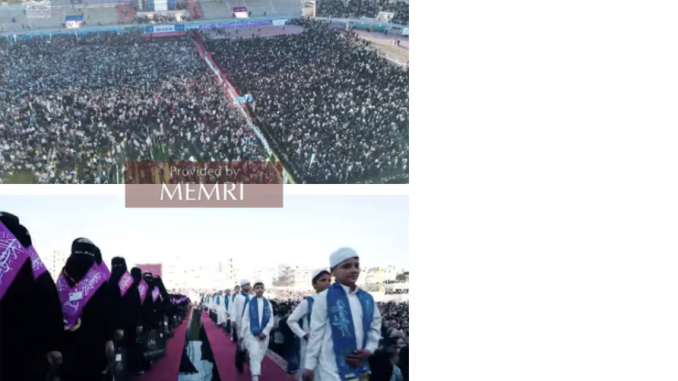 Ceremony held by Dar Al-Wahi Al-Sharif in Idlib celebrating students who had memorized the Quran (Youtube.com/watch?v=WjQqy0yMCtQ, May 5, 2025) Image via MEMRI.org
Under HTS, the curriculum of the Dar Al-Wahi Al-Sharif schools consisted mainly of Quran memorization and religious slogans, encouragement of jihad and martyrdom, as well as the glorification of terrorist operatives from Al-Qaeda, the organization to which Al-Sharaa had belonged. This was reflected, for example, in a third-grade textbook that featured, under the heading “Martyrs of My Country,” a photograph of Muhammad Bahaiya, aka Abu Khalid Al-Suri, who served as Al-Qaeda leader Ayman Al-Zawahiri’s representative in Syria.[31] A sixth-grade English textbook referred, under the heading “Muslim Heroes,” to Samir Al-Suwaylim, aka Khattab Al-Shishani, a Saudi jihadist who fought against the Soviet Union and Russia.[32] For this reason, the network was accused of being “a factory producing new generations of fighters and jihadists and spreading religious ideology.”[33]
After Al-Sharaa rose to power in Syria, the network was subordinated to the Education Ministry and expanded into additional Syrian governorates.[34] This forced it to modify some aspects of its curriculum, but its board chairman, Sheikh Abdullah (aka Abu Ahmad Al-Shawi), a former third-tier HTS leader, clarified that Islamic study material and Quran instruction would remain unchanged.[35]
The promotion of extremist approaches also extended to Syria’s institutions of higher education. In January 2025, fatwa books by Ibn Taymiyyah were brought to the University of Idlib.[36] In August 2025, the dean of the Faculty of Arts at Damascus University banned the use of nude models for graduation projects in the faculty, citing “our moral and social principles.” This decision was seen by some as an attempt to gain favor with Salafist circles.[37]
Islamist Faction Operatives Form The Backbone Of The New Syrian Army
The Syrian army has also taken on an Islamic religious character since the rise of the Al-Sharaa regime. After the fall of Assad’s regime, his army was dissolved and replaced with a new volunteer army based on commanders and fighters from Islamist factions that had been part of or allied with HTS, including foreign fighters, some of whom have been appointed to command positions despite being wanted in their home countries.[38]
The regime also took measures to strengthen the Islamic identity of the volunteers joining the new army’s ranks. For example, a statement issued by the Syrian Defense Ministry in January 2025 noted that one of the conditions for joining the army was completing a course in Islamic shari’a.[39] In March 2025, the Quran Affairs Department and the Endowments Department in Damascus organized a Quran memorization competition for members of the Syrian security forces, with a prize of $1,600 awarded to the first-place winner.[40] Endowments Minister Muhammad Shukri praised the participation of Syrian soldiers in Quran memorization competitions held in mosques, stating that this is “an army that glorifies the sanctity of Allah and memorizes the Noble Quran.”[41]
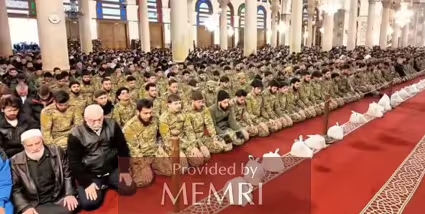 Syrian army soldiers attend mass prayer in mosque (X.com/Omar_Madaniah, May 4, 2026) Image via MEMRI.org
Furthermore, during foot marches, Syrian soldiers have been seen to carry a white flag bearing the shahada, the Muslim declaration of faith (“There is no god but Allah, and Muhammad is His Messenger”), a flag previously associated with HTS and now more generally with several Sunni Islamist organizations.
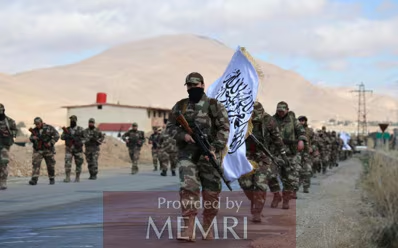 Soldiers on a foot march in the Damascus area carry the shahada flag (X.com/HA_alshami05, February 13, 2025) Image via MEMRI.org
* O. Peri is a research fellow at MEMRI.
[1] HTS began as an Al-Qaeda affiliate in Syria known as Jabhat Al-Nusra. Al-Sharaa (then known as Abu Muhammad Al-Joulani) established it in 2012 at the behest of Abu Bakr Al-Baghdadi, then head of Al-Qaeda’s branch in Iraq. In 2013, after Al-Baghdadi broke away from Al-Qaeda to announce the establishment of ISIS, Al-Joulani remained loyal to Al-Qaeda and swore allegiance to its leader, Ayman Al-Zawahiri. In 2016, Al-Joulani too split away from Al-Qaeda, and his group merged with several other Syrian Islamist groups to become the umbrella organization Jabhat Fath Al-Sham. In 2017, after merging with additional Syrian groups, it changed its name to Hayat Tahrir Al-Sham. HTS was designated terrorist by the U.S. and several other countries. The U.S. revoked HTS’s terror designation in July 2025.
[2] Al-Sharq Al-Awsat (London), December 21, 2024; sana.sy, January 22, 2025.
[3] Al-Arabi Al-Jadid (London), March 31, 2026.
[4] Al-Quds Al-Arabi (London), April 1, 2026. After his remarks sparked widespread criticism in Syria and claims that the regime is turning the country into a theocracy controlled by Salafi-jihadists (Al-Quds Al-Arabi, London, April 2, 2025; enabbaladi.net, April 6, 2025), Arqasousi clarified that his statements represented his personal opinion and not that of the Supreme Fatwa Council (Al-Quds Al-Arabi, London, April 3, 2025).
[6] Facebook.com/profile.php?id=61576002091669, May 8, 2025.
[7] Facebook.com/DamascusGov1, March 16, 2026.
[8] Syria.tv, April 9, 2026.
[9] Alarabiya.net, January 28, 2026.
[10] Syria.tv, May 128, 2026.
[11] Raialyoum.com, April 22, 2025.
[12] Syriahr.com, May 5, 2025; x.com/syria7ra, May 4, 2025.
[13] Al-Arab (London), August 12, 2025.
[14] Verify-sy.com, February 22, 2026.
[15] Facebook.com/Swedenarabs, March 6, 2026; enabbaladi.net, March 5, 2026.
[17] Syria.hr, December 16, 2025, November 10, 2025.
[18] T.me/RudawArabic/82224, April 4, 2025.
[19] Facebook.com/naser.al.naser.860283. March 16, 2026.
[20] Facebook.com/ZAMANALWSL.syria, April 19, 2026.
[21] Al-Arabi Al-Jadid (London), February 19, 2026.
[22] Raialyoum.com, February 6, 2026.
[24] Facebook.com/AbuHafsMuritaani, February 4, 2026.
[25] Facebook.com/abonaboot.huda, February 3, 2026.
[26] Al-Akhbar (Lebanon), February 3, 2026; reuters.com, February 4, 2026.
[28] 7al.net, September 23, 2026; October 2, 2025.
[29] Enabbaladi.net, January 6, 2024.
[30] Syria.tv, April 27, 2025.
[31] Al-Quds Al-Arabi (London), January 24, 2023.
[32] Al-Quds Al-Arabi (London), April 25, 2022.
[33] Almodon.com, December 4, 2023.
[34] In April 2025, it reportedly operated 74 schools and 28 kindergartens (Syria.tv, April 27, 2025).
[35] Syria.tv, October 18, 2025.
[36] Raialyoum.com, January 13, 2025.
[37] 7al.net, August 20, 2025.
[40] T.me/SyMOfE/992, March 18, 2025.
[41] Sana.sy, August 28, 2025.

Leave a Reply
You must be logged in to post a comment.