
| All Israel News | Published: May 14, 2026
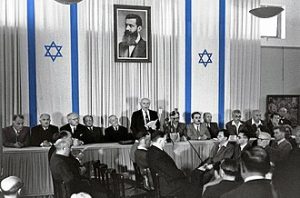 David Ben-Gurion (First Prime Minister of Israel) publicly pronouncing the Declaration of the State of Israel, May 14 1948, Tel Aviv, Israel, beneath a large portrait of Theodor Herzl. Photo by Rudi Weissenstein – Israel Ministry of Foreign Affairs, Public Domain, Wikipedia
May 14, 1948, is considered the birthday of the modern State of Israel. On that day, as the British Mandate officially expired, David Ben-Gurion stood in the Tel Aviv Museum Hall and read out the Jewish State’s Declaration of Independence, in a speech broadcast over the radio.
It is often considered the date the War for Independence began, as five nations: Egypt, Transjordan, Syria, Lebanon, and Iraq, along with a Saudi Arabian contingent, invaded the newly declared state the following day.
However, active fighting between Jews and Arabs over territory actually started on November 29, 1947, one day after the adoption of United Nations Resolution 181, the so-called Partition Plan. This resolution called for dividing the territory of the British mandate, which had already been split into Mandatory Palestine and Transjordan, into two separate territories: one for the Jewish residents and another for the Arab residents.
This plan was accepted by Jewish representatives in Mandatory Palestine, but rejected by all Arab leaders, who were opposed to any Jewish sovereignty in the Middle East.
Seeing the preparations by British forces to leave the area, Arab militias, made up of local Arabs and paramilitary groups from the surrounding territories, began carrying out attacks on Jewish communities throughout the territory of Mandatory Palestine, hoping to prevent the establishment of a Jewish state.
These attacks caused many historic Jewish communities in Gaza and Judea and Samaria to be abandoned, as Arab militias attacked Jews living in those areas, often carrying out massacres to drive them.
The attacks also strengthened armed Jewish defense and militia organizations, such as the Haganah [Hebrew for “defense”], the Irgun [Hebrew for “organization”], and LEHI [Lohamei Herut Israel, Hebrew for “Fighters for the Freedom of Israel”].
Haganah was the underground Jewish militia started in 1920, during the Mandatory period, to protect Jewish communities from Arab violence.
Irgun, an offshoot of Haganah, was founded by that was leaders who felt that a passive defense strategy was insufficient in the face of active, organized Arab attacks on Jews and the unwillingness of the British authorities to stop such attacks.
LEHI was a further offshoot of Irgun, which focused on convincing the British to leave the territory of Mandatory Palestine, especially after the British imposed limits on Jewish immigration to the territory, while refusing to impose limits on Arab immigration.
These organizations acted as defensive and offensive militias, working to counter Arab attacks on Jewish communities, although they were mostly successful in defending the territory allowed for Jewish settlement in the Partition Plan.
Even before Ben-Gurion’s declaration of independence on May 14, 1948, Haganah decided to seize control of the territory allocated to a Jewish state under the Partition Plan. The fighting to establish this control largely took place between April 1 and May 14.
On May 15, just one day later, Egyptian airplanes attacked Tel Aviv, starting the official War for Independence. Initially, the Arab states planned to assist the local Arab militias, but not to commit ground troops to the conflict. However, after hearing that Jordan’s King Abdullah I was planning to seize territory in the areas of Judea and Samaria abandoned by Jewish residents, Egypt’s King Farouk ordered his armies to march on Tel Aviv.
This led to a bloody war, punctuated by two ceasefires, which only ended in early 1949, when the Arab armies began to experience significant losses of territory, after initially capturing much of the territory allocated for a Jewish state.
One of the early Israeli successes was the recognition of the fledgling State of Israel by U.S. President Harry Truman, eleven minutes after Ben-Gurion’s declaration was read aloud. The U.S. thus became the first nation to recognize Israel, lending early legitimacy to the Jewish state.
While the U.S. would attempt to maintain a neutral position for many years following the War of Independence, the increasing support given to the Arab states by the former Soviet Union eventually led the U.S. to begin supporting Israel more openly, in an attempt to prevent Soviet dominance in the region.
That support gradually increased, as Israel’s repeated wars to push back Arab aggression often involved U.S. weapons systems being pitted against Soviet weapons systems with great success.
Israel’s declaration of independence also led to one of the 20th century’s most enduring conflicts, as Arab nations largely refused to recognize or negotiate with the Jewish state, despite the repeated Israeli military victories. That refusal was most clearly seen in the Arab League’s Khartoum Resolution, following the 1967 Six-Day War.
The resolution contained three famous “no’s”:
No peace with Israel.
No recognition of Israel.
No negotiations with Israel.
The “Three No’s” became the cornerstone of Arab policy towards Israel until the 1978 Camp David Accords, which led to the signing of an official peace treaty by Egyptian President Anwar Sadat and Israeli Prime Minister Menachem Begin in 1979. Sadat would later be assassinated over his pursuit of peace with Israel.
It would take another 15 years before another Arab country, Jordan, under the leadership of King Hussein I, signed a peace treaty with Israeli Prime Minister Yitzhak Rabin in October 1994.
In September 2020, Bahrain, the United Arab Emirates, Morocco and Sudan announced formal recognition of Israel, broadening the group of Arab and Muslim nations accepting the reality of Israel’s declaration of independence 72 years earlier.
In 2026, 78 years after boldly proclaiming the return of the Jewish people to their ancestral homeland, the Jewish state has found itself standing against aggression from the Iranian regime and with countries that opposed its creation.
At the same time, the territorial division that sparked the War of Independence has yet to be resolved, while the internal debate over the identity of the Jewish state, which was never settled by a state constitution, continues to shape Israeli politics.


Leave a Reply
You must be logged in to post a comment.