
Peloni: What China needs from Iran is stability in the region so as to exercise its influence while also having free access to Iran’s cheap oil. What China has been receiving for its vast investment in Iran has been something very far from this.
Mariam Gregorio
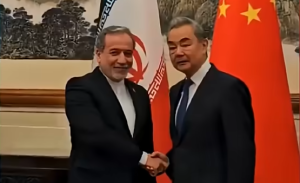 Chinese Foreign Minister Wang Yi met with his Iranian counterpart, Seyyed Abbas Araghchi, in Beijing. Screengrab via Youtube
China has played Vahidi for the fool he is. Vahidi thought he was clever when he blocked the strait; he was outsmarted by Trump. The US has stopped all traffic in and out of the strait, in particular tankers with Iranian oil. As a consequence, the flow of Iran’s crude oil to China came to a halt. Vahidi lost his revenue stream; China was buying 90% of Iran’s oil at a discounted rate. Iran’s economy is in free fall; as a consequence, the currency is worthless toilet paper: 1 USD equals approximately 1.8 million Iranian Rials.
China was never going to wait for Vahidi to reopen the strait; their teapot refineries need the oil. China has pivoted away from Iran. The evidence is overwhelming: Beijing has given Vahidi the middle finger—“Fight your own war, boy, you are nothing to us”—and is building an entirely new energy security architecture.
· They know Vahidi is an irrational, unhinged man: In the immediate aftermath of the February 28th strikes, China moved decisively to secure alternative crude oil supplies, leading to a five-month high in African crude imports from Angola and the Republic of Congo.
· The Chinese government’s hand was never going to play Vahidi’s amateur game: They allowed state-run giants like Sinopec and Sinochem to tap into their emergency commercial stockpiles to weather the immediate shock.
· Diversification from Asia to Africa to South America: The diversification is aggressive and multi-faceted. Chinese imports now come from Brazil, hitting an “all-time high” in April, and Russia has also filled the gap as the strait was blockaded.
· Locking in Long-Term Gains: Crucially, this isn’t just about spot purchases. China is cementing its future away from Iran; they need stable, rational partners.
· Algeria: The Chinese state oil company, Sonatrach, is already working with China’s Sinopec under a major framework agreement to secure alternative supplies. A new $103 million deal for drilling rigs shows the investment is accelerating.
· Morocco: The relationship is so advanced that Morocco and China have now signed a joint statement establishing a “strategic partnership,” with a major focus on the energy sector, including petroleum and green hydrogen.
· Zambia: China is investing over $1.1 billion in a massive new oil refinery in Ndola, which will transform the landlocked nation into a regional energy hub, giving Beijing a strategic foothold in the heart of the continent.
· The Analyst Verdict: A new report from the Stimson Center confirms that China’s pivot to North Africa is a direct result of the closure of the strait by Vahidi, causing the US to enforce a blockade on Iranian oil.
· Beijing is openly telling its officials they must accelerate the shift away from Iran to prevent the Iranian government from “weaponising” the strait again.
The Strategic Convergence: Why this is the End for Vahidi
The US noose is tight around the regime’s neck; all of Vahidi’s talk that the IRGC controlled the strait was outright dismissed by China; he must think they are stupid.
· Inside Iran: Vahidi’s tactic of blocking the strait was a dire strategic mistake.
· Their economic system is seizing up: Unemployment is rising exponentially, and poverty and food shortages are hitting hard. Iranians are relying on staples and skipping meat, chicken, and other foods.
· With the US blockade around Iran’s neck, oil exports have stopped and Vahidi has no storage left.
· No exports mean a permanent loss of its primary source of foreign currency and geopolitical leverage.
· No storage means the wells are about to be destroyed by geology itself.
· Inside Kharg Island: The regime’s cruelty toward minority residents is on full display.
· This madman is now holding Iranian minority citizens as hostages because they are not Shia.
Vahidi lost his number one customer: China is the world’s largest energy consumer; it was never going to negotiate with an irrational, theocratic madman. It has already built the bypass. China has secured alternative oil supplies from Africa, South America, and Russia. Xi is not waiting for Vahidi to open the strait back up—the damage is done. China is actively investing billions to make sure they never have to rely on the Persian Gulf again.
Vahidi’s Catastrophic Mistake:
On Monday, 4 May 2026, the Marshall Islands-flagged tanker JV Innovation—owned by Tianjin-based Ronghe Changyou XIX Leasing and clearly marked with “CHINA OWNER & CREW” on its hull—was struck by an Iranian drone while anchored near Mina Saqr off the UAE coast. The strike triggered a fire on the vessel’s deck. China was furious, summoning Iranian Foreign Minister Abbas Araqchi for a face-to-face meeting with Chinese Foreign Minister Wang Yi in Beijing on Wednesday, 6 May 2026.
Abbas Araqchi, instead of apologising and voicing regret, foolishly denied Iran was responsible for the attack. The diplomatic friction over the denial was highly noticeable. Iran’s official diplomatic apparatus directly contradicted China’s independent findings and intelligence; he treated China with disrespect and disdain. The May 4 drone strike on the tanker JV Innovation was widely attributed to Iranian forces by maritime intelligence.
Then Abdolreza Rahmani-Fazli, Iran’s Ambassador to China, added fuel to the fire by issuing a sharp public denial stating that Iranian forces had absolutely no involvement in targeting the vessel. Iran’s blanket denial directly insulted China; their state media reporting and public intelligence gathering led to a public diplomatic clash.
Iran had the audacity to contradict Beijing’s hard evidence: Iran’s denial came after China’s own highly vetted, state-approved media outlet, Caixin, had already thoroughly investigated the incident, publishing definitive proof that the vessel was Chinese-owned and explicitly marked with “CHINA OWNER & CREW” on its hull. Beijing chose not to quietly accept Tehran’s denial. Instead, Chinese Foreign Ministry spokesperson Lin Jian took the podium at a press conference to officially confirm the attack occurred, directly invalidating and rejecting Iran’s claims as “fake news.”
Beijing then went public: On Friday, 8 May 2026, spokesperson Lin Jian expressed that China was “deeply concerned” about the safety of civilian ships and the fact that its nationals were caught directly in the line of fire, shifting Beijing’s stance from a neutral observer to a vulnerable stakeholder. China publicly made it clear it did not believe Iran’s excuses and was deeply offended that its status as Iran’s primary economic lifeline was met with attacks on Chinese citizens from careless regional drone strikes.
This created an incredibly tense atmosphere. China was heavily offended that Iran’s military missteps endangered its sailors, and even more frustrated that Iran chose to lie about it rather than apologising and offering private concessions and safety guarantees for Chinese transport.


Leave a Reply
You must be logged in to post a comment.