
Seth J. Frantzman | Mar 4, 2026
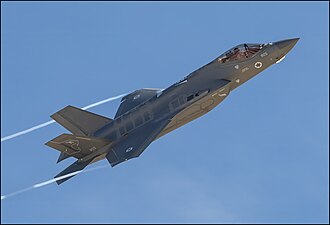 Israeli Air Force (IAF) F-35I Adir. Photo by William LewisDerivative: User:MathKnight – WikiCommons: File:230322-F-UT528-1038 – Red Flag-Nellis 23-2, 22-24 Mar, 2023.jpg, CC BY-SA 4.0, Wikipedia
Israel has carried out 1,600 “strike sorties” against Iran since the joint US-Israeli military operation began on the morning of February 28, the Israel Defense Forces (IDF) said on March 4. Iran has responded by launching hundreds of missiles and drones at Israel, resulting in 10 people killed and dozens wounded over the first four days of the conflict.
“Over the past 24 hours alone, hundreds of Israeli Air Force fighter jets and aircraft conducted more than 300 consecutive waves of strikes,” IDF International Spokesperson Lieutenant Colonel Nadav Shoshani said. An Israeli F-35 warplane also downed an Iranian Yak-130 combat aircraft, the first air-to-air combat for the Israeli Air Force against an enemy manned aircraft in 40 years.
Iran continued retaliatory strikes on Israel, including launching ballistic missiles, on March 4, with at least seven waves fired and detected by 5 pm.
The Israeli military noted on March 4 that it was now simultaneously conducting strikes against both Iran and Hezbollah, the Iran-backed Lebanese terrorist group that has launched rocket and drone attacks at Israel during the conflict. The IDF also “struck and dismantled the [Tehran] regime’s secret nuclear compound known as ‘Minzadehei.’ At this site, a covert group of nuclear scientists operated in secrecy to advance the knowledge and capabilities necessary to obtain nuclear weapons,” Shoshani noted in his briefing.
“This operation is directed at the Iranian regime and its military and terror infrastructure — not at the Iranian people. Our actions are precise, intelligence-driven, and focused on removing threats before they can materialize,” Shoshani added.
Iran has continued to strike at Israel with drones and ballistic missiles throughout the conflict, launching salvos of projectiles several times a day each day. For instance, on March 4, there were incoming salvos just after midnight, just before 1 am, and at 4:18 am. More Iranian missile attacks occurred at 5:53 am, 1:48 pm, 2:31pm, and 4:07 pm, according to the IDF’s list of alerts issued to phones in Israel on March 4. A similar pattern of Iranian launches targeting Israel, from the early morning to the evening, took place each day of the conflict.
In total, Iran has launched 500 missiles and 2,000 drones during the first four days of hostilities, according to Admiral Brad Cooper, the head of US Central Command (CENTCOM). These weapons have targeted Israel and at least 11 other countries.
The Israeli Home Front Command of the IDF uses a multi-layered approach to warn people of incoming projectiles. An initial alert is sent to a large area of Israel, triggering an alarm on people’s phones. The IDF says in each instance that it has identified a missile launched in Iran. Within around six to 10 minutes of the initial alert, sirens sound in areas of Israel threatened by the projectiles and the possibility of falling debris from interceptions.
“Upon receiving an alert, the public is instructed to enter a protected space and remain there until further notice. Leaving a protected space is permitted only after receiving explicit instructions. The public is requested to continue acting in accordance with the Home Front Command’s guidelines,” the IDF says. For instance, the sirens that sounded at 4:16 pm on March 4 affected an area of approximately 1,500 square miles. This estimate is based on a list of communities affected by sirens shown on the Hebrew Red Color website and Telegram account, which track the alerts and sirens.
The attacks that have caused sirens in Israel have mostly been from ballistic missiles rather than drones or other projectiles. This proportion is also reflected by the IDF’s published warnings throughout four days of war, which have primarily referenced Iranian ballistic missile threats. The IDF said on March 1 that it downed 50 Iranian unmanned aerial vehicles (UAVs), although it was unclear if those drones had reached Israeli airspace or threatened Israeli communities.
After Hezbollah began launching attacks on Israel on March 2, the number of sirens in Israel due to drone threats increased, primarily in northern Israel. The audible alerts warning of drone threats are the same as those for missiles and other threats. The major difference is that early warning alerts sent to phones are not sent during drone attacks, as they are detected with less notice.
The IDF began its strikes on Iran on February 28, and by that afternoon, the Israeli military said it had overflown Iran with 200 fighter jets. “This is the largest military flyover in the history of the Israeli Air Force (IAF), conducted following accurate planning and based on high-quality intelligence, while synchronizing hundreds of fighter jets at the same time. The IAF’s fighter jets dropped hundreds of munitions targeting approximately 500 objectives,” the IDF noted.
In the first 24 hours, the IDF added that it had conducted 700 sorties in Iran and downed 50 Iranian unmanned aerial vehicles. In addition, the IDF noted that it had targeted Iranian leaders, missile launchers, and 600 “terror sites.” The Israeli military published an infographic on March 4 showing the variety of targets it had hit in and around Tehran. By March 4, the Israeli Air Force said it had used 5,000 munitions in strikes on Iran. In contrast, US Central Command said it had launched 2,000 munitions at 2,000 targets in the first 100 hours of the operation.
The Iranian missiles on Israel that have killed at least 10 people and injured dozens morehave hit several targets. On the first night of the conflict, a missile hit a street in Tel Aviv, damaging and destroying numerous buildings and killing one person. On March 1, a missile struck in a residential neighborhood near a synagogue, killing nine individuals. In the southern Israeli city of Beersheba, a missile impact on March 2 forced more than 1,000 people to evacuate their homes.
Israel’s civilian airports remained closed on March 4. Israel also partially evacuated its embassy in the United Arab Emirates due to Iranian terror plots, The Times of Israel reported.
Reporting from Israel, Seth J. Frantzman is an adjunct fellow at FDD and a contributor to FDD’s Long War Journal. He is the senior Middle East correspondent and analyst at The Jerusalem Post, and author of The October 7 War: Israel’s Battle for Security in Gaza (2024).


Leave a Reply
You must be logged in to post a comment.