
UPDATE: Benny Gantz withdraws from the election race.
PELONI: October 7 changed everything, and among the aspects of Israeli society involved in that change, Netanyahu is today offering the public an opportunity to fully grasp the long range of Netanyahu’s strategic posture for the future, making it a pivotal point on which the coming election will hinge. Notably, Eisenkot and his Leftist colleagues can weigh in on this strategy with their own support or opposition, but the reason that Eisenkot has not voiced a clear message on what would be changed in Israel’s policies from that of Netanyahu was not a point of error but intentional omission. That omission is today being brought into full light with this disclosure by Netanyahu. I encourage everyone to read the full transcript below. The video was 45 minutes long, so the transcript is not short, but it is well worth being scrutinized.
Prime minister warns of ‘tragedy for generations’ if opposition wins election
J. Micah Hancock | All Israel News | Published: October 19, 2026
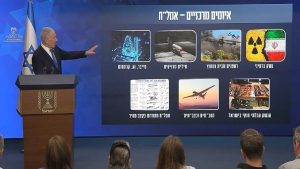 Image via Youtube. Hebrew Video Loads below AIN Article with Translation at the Bottom.
Prime Minister Benjamin Netanyahu presented his new national security doctrine on Sunday, in his first in-person press conference with Israeli media since the Oct. 7, 2023, Hamas terror attack.
The document outlines a major shift in Israel’s security strategy, moving away from the policy of containment described in a 2018 strategy document, issued during Netanyahu’s previous term as prime minister, toward pre-emptive action against threats, particularly from the Shi’ite-led axis of Iran and its regional allies.
Netanyahu said the recent multi-front war had prompted a reassessment of Israel’s traditional security concepts. The new approach prioritizes prevention and offensive action over containment and defense, greater independence in arms production, maintaining technological superiority, combating global antisemitism and building new regional and international alliances.
He identified the core threats facing Israel as the Shi’ite Axis; nuclear and advanced weapons, such as precision-guided ballistic missiles and drones; Palestinian terrorism and domestic security threats, including weapons smuggling; delegitimization and isolation attempts; and artificial intelligence and other technological threats.
Netanyahu placed the Islamic Republic of Iran and its proxies at the top of threats to Israel, telling the gathered journalists that he intends to topple the Iranian regime.
Prime Minister Benjamin Netanyahu Issues Israel's National Security Doctrine to the Public:
"The October 7, 2023 attack compelled Israel to wage a fierce war. Through continuous combat – from Gaza to Yemen, from Lebanon to Iran – Israel warded off an imminent existential nuclear… pic.twitter.com/MjvX8sRZIY
— Prime Minister of Israel (@IsraeliPM) October 18, 2026
“The regime must fall, and I will bring it down,” Netanyahu stressed. “Our plan is a very comprehensive and very determined plan to bring about the fall of the regime. That is my plan. That is the directive I have given all the security agencies, and that is what will happen,” he added.
He also said that the goal of toppling the Iranian regime does “not depend on American agreement.”
“As long as necessary, we will act independently,” Netanyahu stated. “We have done so already, and if necessary, we will do so again.”
Regarding the war against the Hamas terrorist group in the Gaza Strip, Netanyahu said Israel would not allow the reconstruction of infrastructure until full military demilitarization was achieved, while arguing that if Iran is defeated, Hamas would collapse “on their own.”
He said his government had approved an “Emirati enclave,” a designated area in Gaza where the United Arab Emirates (UAE) would help establish temporary housing and infrastructure for displaced Palestinians, in territory currently controlled by the IDF.
“We will not allow reconstruction in any part of Gaza before Hamas is disarmed,” Netanyahu said. “We agreed to an Emirati enclave adjacent to our security zone. The mission of eliminating Hamas will fall to us. If Iran collapses, they will fall on their own.”
The prime minister expressed doubt that either Hamas in Gaza or Hezbollah in Lebanon would be disarmed by any means other than Israeli military action.
As part of this new security doctrine, Netanyahu called for increasing the defense budget by nearly NIS 450 billion ($145 billion), to be used for increasing Israel’s weapons independence.
“Our international partners should depend on us, not on them,” Netanyahu said.
Regarding core material threats, the prime minister placed Iranian nuclear weapons at the top of the list. “We are prepared to take the initiative,” he said. “We must prevent the enemy from delivering the first blow.”
He ranked drones, particularly fiber-optic drones and drone swarms, as the second-greatest threat, ahead of ballistic missiles. He warned that such weapons could be used to strike critical infrastructure and political and military leaders.
Below those threats, Netanyahu ranked ballistic missiles, followed by artificial intelligence and quantum computing technologies, which he warned could be used to develop systems capable of paralyzing critical infrastructure ahead of a traditional military attack.
Netanyahu also warned of a growing axis aligned with the Muslim Brotherhood and led by Turkey, which he said could replace Iran as a regional threat. He described the threat as a shared concern that was driving greater regional cooperation.
Israeli media largely viewed the press briefing as a political event, given that it came just eight days before the election.
During the briefing, Netanyahu warned that if his political opponents won the election, Israel’s ability to win the conflict would be in jeopardy.
“I fear for the future of the state,” Netanyahu told reporters, saying a victory by the opposition would be “a tragedy for generations.”
He repeatedly insisted that the completion of his new security doctrine depends on his coalition remaining in power after the election.
Netanyahu also addressed recent violent incidents in Judea and Samaria involving Jewish settler activists targeting Palestinians. While arguing that international media have exaggerated the scale of the phenomenon, he condemned the attacks.
“I think the real danger is that we’re actually facing a major propaganda campaign surrounding these young rioters, who really are causing us enormous damage,” he said, adding: “That is why I brought in the Shin Bet for the first time, and we will employ additional measures to root this phenomenon out completely.”
Netanyahu promised to renew the State Comptroller’s investigation into the Oct. 7, 2023, Hamas massacre and work toward establishing a national commission of inquiry composed of representatives from both the coalition and opposition.
He said only such a commission would be trusted by the majority of Israelis.
Some media outlets boycotted the briefing over Netanyahu’s failure to engage with Hebrew-language media following the Oct. 7 attacks and reports that several journalists known to be critical of the prime minister had not been invited.
Translation:
Ben-Gurion presented three or four principles. He called it the national security doctrine, and this is important: it provided direction and a compass for our forces. This was close to the establishment of the state. So, what lessons did he draw from the War of Independence and its aftermath?
About ten years ago, more or less, I formulated a security doctrine and presented it to the heads of the organizations as well. It has changed considerably since then. It has changed in the sense that things have been added and things have happened. They called it the War of Revival and its aftermath, during which we had already begun changing the security doctrine.
I would say that, at the beginning of it, a fundamental change in our security doctrine began, which I will of course present here.
The October 7 attack compelled Israel, first of all, to fight back and engage in continuous combat, from Gaza to Yemen, from Lebanon to Iran. Israel removed from itself the imminent and immediate danger of nuclear annihilation.
Iran was developing atomic bombs. Had it not been for the actions of the people [unclear: “????”], by the time of Operation Rising Lion, they would have had atomic bombs to destroy us. We need to understand this. This is the first and foremost security fact that we must recognize and address at all times.
Therefore, we removed from ourselves the danger of this imminent and immediate nuclear annihilation. At the same time, we also removed the stranglehold that Iran had built around us with its proxies. We crushed them. We also, how should I put it, entered their territory.
You know all these things, and I will address them shortly. Two existential threats have been removed: the nuclear threat and the threat of the stranglehold formed by the proxies [clears throat]. The government and the security cabinet made informed decisions, and I would also say very courageous ones. The fact is that we really changed the entire course of the country.
The IDF and the security branches attacked with great force, and the civilian home front stood with us throughout the War of Revival.
At its beginning, a change and refinement of fundamental principles in our traditional security doctrine took place.
I will mention several of them, and shortly we will discuss them in a more orderly fashion.
First of all, prioritization. This means giving priority to prevention and attack over containment and defense. You do not contain; you act proactively to prevent dangers, including launching a preemptive strike—in fact, preemptive strikes—to thwart significant threats.
You saw this with Nasrallah, with the pagers, and you saw it in Iran. You saw it in Syria as well. This is an enormous difference, an enormous difference from the outset. I will touch on this further later.
Strengthening home-front defense against new threats. The home front must be protected, and in order for it to be protected, you need to take various defensive measures, not only offensive measures. Defensive measures must also be constantly updated, including these days.
I will give you many details, though I cannot disclose everything. Unfortunately, I cannot even disclose everything in this forum. But I think you can, of course, understand the main point from what I am saying.
Another thing is building substantial independence in ammunition. We saw this during the War of Revival, under Biden. You saw what happened here, and we do not want to reach that situation. We know that we could reach it. Therefore, our national security doctrine—my security doctrine—requires strengthening our independent ability to manufacture ammunition for all our weapons systems.
We can find partners for this, but the partners must depend on us, not us on them. That is a very big difference. This rearmament must also take place in industrial and technological facilities underground.
For this purpose, how much have we allocated? NIS 400 billion, already more than that. Close to NIS 450 billion in additional funding for our defense budget, which necessarily continues to grow.
Of course, ensuring an advantage in the most advanced technologies is essential. That is clear. We are in an immediate technological race, and we must be not merely another player, but a leading player. In cyber, we are second in the world in foreign investment in cyber, after the United States. We need to reach a similar position in AI.
I mention this here; I will elaborate shortly. It is critical. And Israel must be a regional power, and in several areas even a global power, because we face a range of threats that I will detail shortly, and we must possess an extraordinary degree of superior capability and strength.
Of course, from this [clears throat], we can also—and already do—create new alliances with many countries. I emphasize this: many countries. You know about one or two; you hear about them in the media. That is just the tip of the iceberg. This is a direct result of the empowerment that has already taken place.
These principles are not something we are going to implement in the future. Essentially, I am giving formal expression here to what we are already doing and will continue to do. That is what needs to be said. It is already being implemented, and it will be implemented even more extensively going forward.
These are my introductory remarks on a security doctrine that is very active, very proactive, very proactive, and intended to change the face of the Middle East.
And I want to tell you that it has already changed the face of the Middle East. It changes it every day.
Israel is stronger than ever, and Iran is weaker than ever. Its axes are weakened, but there is still work to be done to complete the process.
First of all, this means bringing down this regime, finally overthrowing it. We are working on this, and we will do it. Of course, subsequently, or in parallel, we will completely eliminate Hamas and Hezbollah. These are things that are certainly within our capabilities, and they will come in their proper order. But first, the head of the octopus. First, the head of the octopus.
For 47 years, no one dared to attack it. No Western country had attacked it; the idea had never even crossed their minds. We did it because of the change that took place here.
I want to conclude these introductory remarks by saying that we changed the face of the Middle East because we changed ourselves.
Everything I have told you so far, and everything I will present here, is essentially a fundamental change in our security doctrine: in its aggressiveness, its initiative, its ingenuity, and its willingness to venture outward.
When I say venturing outward, I mean Israel’s ability to reach very far, including, if necessary, establishing bases far from Israel.
I want to address the main threats first.
The first and foremost threat is nuclear weapons. We need to understand what nuclear weapons mean.
This is the first thing.
My throat is hoarse from explaining to the public what is at stake. I say this in principle. People come to me with this issue and that issue . I tell them: the issue is our very existence.
Only a year ago, we faced the danger of a fanatical Islamist extremist regime that was about to complete the production of several nuclear bombs intended to destroy us.
This is how it is, as they say, amid the tumult of elections, amid the clouds of smoke—thank you very much—amid the clouds of smoke and the uproar that surround us. This is the issue, and I treated it as the foremost threat.
This is because an Iranian leader said that Israel is a one-bomb country. Drop one bomb on it, and it is finished. Not only because you would kill several hundred thousand people in a single strike. With bombs, you can kill millions, but you can also destroy the country. It is very small, very small and very concentrated. A nuclear bomb means annihilation—the annihilation of the state.
Therefore, I devoted decades of my life to preventing this regime from obtaining nuclear weapons.
It went so far that this became Netanyahu’s obsession. That is what they called it. Once again, another Netanyahu spin. Iran again. What is he talking about? And I had to fight not only external apathy and contempt from abroad, but also active opposition from security officials at home.
Not everyone, but most of them. Almost all of them. Because I identified Iran’s nuclear weapons as an existential threat from a regime that had made our destruction its declared objective, both to take control of the Middle East and to advance its plan to take control of the West.
“Death to Israel, death to America.” This death is to be carried out through atomic bombs, and the means of delivering them were ballistic missiles. And, of course, ultimately, intercontinental missiles, which they have already been working on. They are already reaching Europe and intend to reach the United States.
This was the situation we faced at the beginning of this campaign. Therefore, we had to act against this threat. This is the supreme threat.
It is not the Netherlands with nuclear weapons, because the Netherlands is also becoming an issue. Yes. This is not a joke. A joke. This fanatical regime cannot be allowed to possess nuclear weapons.
We faced this threat, confronted it, and thwarted it. But I will discuss what comes next shortly.
That is threat number one.
The second threat—and its ranking will surprise you, although it is still very high—is drones, both domestic and foreign.
Whereas nuclear weapons sit at the top of the pyramid of threats against us, and are technologically sophisticated, difficult to develop, and possess enormous explosive power, drones decentralize the ability to act against you. Any child, any actor, can use them.
Not only that: you can deploy swarms, and you can equip them with AI. This means that you can concentrate firepower on an adversary’s vulnerable points. It means our command centers; we become blind. It means communications hubs. It means all kinds of national infrastructure. It means leaders. It means a push against a thousand people. You can take a list of a thousand people; it is not difficult to reach them. You can get to each and every one of them.
Now, when I say drones from within and from outside, you can see what I mean. A drone from outside, say, in Lebanon. Okay? So we need to prevent two types of drones from crossing our borders.
One type—we can actually divide them into three types. We can detect and bring down the conventional types. But there are two other types.
One is a fiber-optic drone. You know these; you have seen them. From our perspective, a fiber-optic drone has one advantage: it has a belly, and we are essentially organizing defensive lines along all our borders that simply cut its belly.
The second is a SIM-controlled drone, for which there are electronic solutions, but it is a challenge.
And what happens if it comes from Ramla? Or what happens if it comes from Ramat Gan? What happens if it comes from here, from Romema?
This is an enormous challenge, a global challenge. All countries are dealing with it. We have established a special task force. Perhaps I will be able to say a few words about it, but this is the second threat.
In other words, at the top end, advanced technology; at the lower end, simple technology that your children can operate and attach simple explosives to. An enormous threat.
The third threat is precision missiles. We saw the ballistic missiles here.
The ability, once again, to strike—not statistically, which is already difficult enough, but to hit our offshore platforms, to hit the Kirya, to hit anything, and to bring down a thousand kilograms from the sky. A busload of explosives comes down at Mach 6, with multiple warheads that separate.
Everything you saw represents a major threat. We actually prepared relatively well for this particular threat, and of the nearly one thousand such missiles launched at us, the damage they caused was small. But that could change.
We certainly do not want Iran to have thousands of missiles, essentially tens of thousands of missiles. That was their plan. Therefore, in the operation [unclear: “?? ????”], by the time Operation Rising Lion began [unclear], we eliminated most of their production capability.
But again, I will soon get into what we will need to do. This is what we have done. All these things I am discussing relate to existing threats and threats we have dealt with, but they still lie ahead of us.
The fourth threat is cyber, artificial intelligence, and quantum technology. I rank it fourth. I am not sure it will not eventually take first place, and I will explain why.
Artificial intelligence gives an enormous advantage to whoever possesses superior intelligence. What do they call it? Cyber intelligence? Yes, because you can essentially paralyze a country.
Is there anything here that does not operate on digital systems? Tell me, because I would be happy to hear it. I know that libraries still do not operate digitally. You go there, and they cut it off for you. That, too, will eventually reach all our systems: communications, energy, transportation, healthcare—everything operates on systems.
All systems operate on digital systems that you can simply take control of and use to paralyze a country. You can paralyze the economy. You can simply paralyze life, from traffic lights in the north onward. Everything, everything, everything.
Therefore, if another actor, a foreign actor, has such superiority over you, it could be a government, it could be a company, or it could be a government and companies together. You could be brought to a standstill.
Therefore, the response—I am not talking only about cyber. Cyber is a threat in which we have significant advantages because we did this; we built it. Again, a decade ago, I said we would become one of the five great cyber powers.
They laughed at that, too, and scoffed: a virtual prime minister, and so on and so forth. But today we are the world’s second-largest cyber power in terms of investment, and we are a cyber power in both defense and offense.
But this is a threat that is constantly evolving. The major threat is the combination of these two things, AI and quantum technology. This is the ability to take control of a country, paralyze it, and bring it to its knees.
We must be among the three cyber superpowers in the world. I am not saying first or second; we do not need to exaggerate. We cannot compete with the United States or China, but we can certainly be third, and that is imperative.
To achieve this, certain things must be done, especially developing our energy capabilities, which are an essential condition.
The next threat is illegal weapons within Israel.
I am saying that there are also large weapons stockpiles in Judea and Samaria. I requested and received a plan [unclear] that was presented to me about three weeks ago, approximately. In that plan, there is the question of reversing the guns—the reversal of the guns. What is the reversal of the guns? We are undertaking this reversal of the guns, in essence [recording unclear; audience reaction].
An extraordinarily powerful plan was presented.
If I had to explain what it means, it is essentially to conquer and destroy all the centers of threats against us originating in Judea and Samaria. A parallel plan is currently being developed for threats originating within the country, because these are possibilities that could arise. Some have already materialized, and we are not waiting for them.
This is a very significant threat.
The next threat is unmanned aircraft and unmanned aerial vehicles. Of course, this is a greater threat than drones, as you know. In the air, it changes aerial warfare, both defensive and offensive, because we, too, as they say, are not exactly absent from this field. We brought this technology into the world. We invented the first such aerial systems.
But pay attention: the same systems also exist at sea. Exactly the same systems. They are not visible; they cannot be detected. You can then use them to threaten our entire maritime area, whether the entrance through Bab el-Mandeb or the entrance from the Mediterranean Sea.
This is a very serious threat. It can paralyze your economy.
Again, we must address this both defensively and offensively, and I will elaborate as much as I can. I attach great importance to this, and this is also the instruction to the IDF.
The other thing I want to address is the pace of change in warfare.
The pace of change in warfare is enormous. In the past, you could make a plan: I will develop this unmanned system over five years. There is no time for that anymore. The speed at which it changes—the speed at which it changes because of AI—is enormous.
I invited Palmer Luckey here. Palmer Luckey heads a company called Anduril, which, in my opinion, is the world’s leading weapons manufacturing company. It is in the United States and is very powerful.
He discusses the possibility of underground penetration. He talks about underground unmanned systems—not systems that you launch and that travel through the air, but systems that move underground. Sorry, yes, yes. We will discuss other things as well. I will not go into that.
But the reason is that we must remain at the forefront at all times, and this is moving at tremendous speed. Therefore, alongside developing these defenses and these offensive capabilities, we must develop the ability to combine AI with development, shorten the timelines, and provide the budgets to protect them underground so that we can develop them without interference.
This is the cluster of main threats. More could be added, but I think I have covered both what we faced and overcame in [unclear: “?? ????”] and, of course, in the War of Revival, as well as what we will face in the coming years.
I would say that this is essentially the concentration of the major threats facing the State of Israel.
That is the subject of warfare. Now I want to address the theaters.
First of all, there is the main axis. The main axis is one we know. There is also the parallel axis. The parallel axis is, in practice, led by Turkey. One is led by Iran, whose regime we must overthrow, and the other by Erdogan.
Now let us look at the next threat. The next threat is the convergence of the axes.
They can converge and create a cluster of threats around us. Two enormous threats that would, of course, threaten the entire region.
One of the things working in our favor, and which we are pursuing, is that the convergence of the axes concerns not only us. It concerns, I tell you, most of the countries in the region.
As a result, they come to us. They may publicly condemn us in front of everyone, on the world stage, and then say afterward, “No, we did not mean it. We did not mean it. Come, let us do something. Help us,” because they fear this no less than we do.
This is both a threat and a catalyst for creating alliances. These alliances are being forged at this very moment.
The third theater is, of course, terrorism and internal security threats. I have addressed part of this. In other words, we could face this within Israel itself, from Judea and Samaria, and from what remains of Gaza. But I believe we will overcome it and eliminate it.
And, of course, there are also threats from Lebanon. These are more immediate threats, and we are dealing with them with considerable success, including through the change in our approach: an offensive, proactive approach.
That is why we entered the refugee camps. They were not refugee camps. They were not refugee camps; they were essentially terrorist strongholds. We entered and destroyed them. We remain inside them, and we reduced the level of terrorism to zero.
Unfortunately, we have seen several tragic incidents here, but overall it has fallen by 80% as a result of that same offensive, proactive approach, preemptive strikes, ingenuity, and the proactive use of force.
We will apply these two principles both against internal terrorism and against terrorism from Judea and Samaria and the territories surrounding the State of Israel.
And, of course, the next objective—or, more accurately, the next theater—is the international arena, where there is a clear attempt to deny us legitimacy and isolate us, to separate us from our allies.
Part of this consists of global phenomena also occurring within the West, within the United States: the entry of highly dominant Islamic elements. The connection between the green [unclear] and the [unclear]—that is, the far right, at least in the United States, and the legitimization of the combination of the left and Islamist movements—is a global phenomenon.
We need to find ways to reduce it through various means. But I would also say that we must once again mobilize support. Remember that every such issue, every threat, is not only a threat to you; it is also an opportunity to create alliances with those affected by the same phenomenon.
That is exactly what we are doing with large countries, even very large ones, and with other countries. We are creating alliances as well. There is also a question of technology here, which I will address shortly.
Finally, I would say that the last issue is border defense.
Border defense. I have been talking all along about offense, offense, offense, ingenuity, and so on. But we are also strengthening our borders.
What are we doing? Essentially, I established, as you know, the ground barrier between Israel and Africa along the Egyptian border. It was fundamentally a barrier against infiltration. Otherwise, there would already be another million Muslims here, and we would be flooded as Europe was.
That was prevented. We brought the numbers down to zero.
But this is also a means of defense, a defensive line that is fundamentally offensive. In other words, you concentrate forces in order to launch a preemptive strike or a strike beyond the barrier to prevent an invasion of your territory.
There is an intention to invade the State of Israel. Iran speaks of what I would call a third form of annihilation: nuclear weapons, [unclear], if you will. It is not just nuclear weapons. Please stop that. The axis—
The renewed stranglehold, if they succeed in rebuilding their proxies; and the third thing is an invasion of the country.
The country is small. If you can bring half a million or a million people to the borders, you must be capable of stopping them along all the borders.
Therefore, we built security zones. Sorry, go back, go back, go back.
We built security zones, first of all in Gaza, the Gaza perimeter area, inside Gaza, until we complete the elimination of Hamas, of course.
The Lebanon perimeter is inside Lebanon, in an area that is essentially emptied of its population. And, of course, in Syria, the same thing applies, from Mount Hermon to the Yarmouk.
First of all, you must be there. You have to isolate them. That is the principle: you separate Israeli civilians from terrorist forces. They cannot reach us. They cannot dig tunnels. They cannot infiltrate us underground.
This is a very important defense, and we are completing it along the eastern border.
I was there the day before yesterday, along the entire eastern border. We are building a very strong barrier. But again, we are not relying on it alone. It also has barriers against drones, and it includes arrangements for forces that move on the other side, as well as, of course, an air force capable of destroying an invasion.
It is a combination of defense and offense to protect the borders, including in the north. The northern border essentially runs from the sea to the Yarmouk.
Now, from the Yarmouk to [unclear], and then from Eilat, of course, to the Gaza Strip, as well as the Gaza Strip itself.
Regarding all these things, people ask, “What do you want?” Someone once asked me, “Do you want Fort Israel?” I said, “Of course, of course I do.”
The question is that we want to defend ourselves. A country that does not control its borders does not control its future.
That is what we saw in Europe. It is essentially the struggle taking place in the United States. If you do not control your borders, whether against illegal immigration or against attacks, you are essentially abandoning the homeland in which we invest enormous resources.
This is being built, and it is being built well. I must say that it is progressing faster than the schedule we set, because I placed an exceptional person in charge, someone who proved himself in building the barrier in Egypt, and he is now doing the same in the other theaters.
All right. These are the main threats, both in warfare and in the theaters.
Now I want to present to you the ten principles guiding our actions under the security doctrine that I am setting out here. I will also give you these points in writing.
We will shortly establish the rules and explain how this is done.
The central principle, the first one before the ten, is this: the State of Israel must first and foremost have an advantage in military capabilities.
The State of Israel must always be one step ahead of its enemies. It must prevent enemy attacks and enemy force buildup, ensure an advantage in capabilities over all its enemies, and not rely on the intentions of enemies or friends, which may change in the blink of an eye.
I think this distinction is fundamental.
Whether they are deterred or not, whether they want to or do not want to, and so on—that is not what matters. What matters to us is the ability of enemies to attack us.
Because desires, wishes, and intentions can change in the blink of an eye. In the blink of an eye.
We must and are required to ensure superiority in capabilities, both to deter and to defeat, and also to ensure that we can launch preemptive strikes.
We must have the capabilities. An advantage in military capabilities is a fundamental distinction. It is different. It is different from what existed before, and it has been different for four years already. Not three years, certainly. It is different. It is a year [unclear].
I changed this already. I simply took the [unclear] and said: this is what we need to ensure. And to ensure it, you need ammunition, action, and initiative.
So let us see what actions are required.
The first action is preventing nuclear weapons. I have said this, and I do not want to elaborate beyond what I have already said. I think it is clear to you, but this includes proactive offensive operations. In other words, you do not wait.
As a child, from time to time, I would get into fights in the neighborhood. People would fight in the neighborhood, and I discovered a very simple rule: whoever strikes first has an enormous advantage.
You come and punch the person who is about to attack you, and if you strike first, you have an enormous advantage.
This means that we must be ready to act proactively. That is exactly what we did a little over a year ago in [unclear: “?? ????”]. We took the initiative and went to the White House.
I came to Trump and said to him, “Here is what I am going to do.” I was not asking for his permission. “Here is what I am going to do: first action, second, third, fourth, fifth, sixth. There is one action that, if you wish, I would very much welcome your joining. I am going to do this either way. Take the B-2s and strike Fordow. That is what I am asking. If you can, thank you. But in any case, we are going ahead.”
He joined on the tenth day. After that, we delivered a very powerful blow.
We eliminated their leading scientists, their nuclear scientists, and their senior commanders, and we attacked their facilities.
But it is like removing cancer. You remove a cancerous tumor, because if you do not remove it, you will die. You will simply die. A cancerous mass will spread, and you will die.
But that does not mean there will not be metastases.
Indeed, after that attack, Khamenei [audience reaction] essentially led a process of rearmament—literally, the building up of weapons—and an attempt to construct an even more fortified underground system, to continue and complete their nuclear program.
Therefore, we launched Operation Roaring Lion, eliminated more scientists, destroyed more of their facilities, and eliminated more of their capabilities.
By the way, this also included their ballistic missile production capabilities. As I said, their production infrastructure was severely damaged. Today, they were supposed to have thousands upon thousands of ballistic missiles. They are unable to produce them.
But again, after you have done this, there is no guarantee. In fact, the opposite is true: as long as this regime survives, even if it is battered, even if its economy is battered and its military is battered, even if its navy is gone and its air force is gone, it still has an apparatus and the ability to kill its own people, and that is how it survives.
And we must act. If it recovers, it will rebuild its nuclear and [unclear] capabilities.
Therefore, we have no choice but to ensure this. It is a supreme objective.
This has accompanied me throughout my life. These are not merely words I say for appearances. This has been the work of my adult life, at least.
And this is what we did here, something no one believed we would do. We did it ourselves. And, by the way, if we need to act alone, we will act alone, because we cannot live alongside enemy states that are determined to destroy us, declare that they want to destroy us, and actively work to destroy us.
Therefore, this is a supreme objective.
The second principle is, of course, deterrence.
When I say deterrence, I mean establishing a credible threat through the possession of the capability to deliver precise and massive firepower. This means thwarting and disrupting military and civilian systems.
Deterrence also results from the actions you take. When you take strong action, you deter.
The best proof of this is what is happening now. Look at our enemies.
First of all, let us talk about Gaza. You keep taking them down, taking them down, eliminating their commanders, eliminating the Nukhba forces.
Many of them are frightened. They say, “Something terrible could happen. We may be eliminated right now.” They do not want that. They know it is coming.
Or, alternatively, look at Hezbollah. The same thing is happening.
But look at Iran.
Iran attacks everyone, everyone, all the countries in the region. Beyond the region, they attack the United States; they attack the ships of the entire world. But there is one actor they do not attack, and that is Israel.
Now, deterrence does not last forever, but it lasts as long as you continue to develop a proven capability to strike your enemies.
Just do not rely on it. Maintain it, but do not rely on it.
The third principle is warning. This means obtaining and maintaining a continuous and effective intelligence picture of the enemy’s capabilities and intentions in order to prevent surprise.
Capabilities first, and intentions as well, but above all to prevent them from delivering the first strike.
The first strike is so vital that this must be understood.
And this requires a fundamental change in outlook. People were afraid. They were afraid: what if we make a mistake? [Audience reaction.] A miscalculation with Hamas, a miscalculation with Hezbollah, a miscalculation with Iran.
The opposite. Strike. Strike. And put yourself in a position where you can see the picture, understand where it is heading, both in terms of intentions and capabilities, and act in time.
In any case, warning is very important.
The fourth principle, perhaps the heart of the matter, is initiative, ingenuity, and a critical approach.
I sit in meetings. Shmuel, who is sitting here, can testify to this, and Fox is not here, but he could describe it to you. I encourage the various organizations to express their opinions.
More than that, I encourage people within the various organizations, including in my own office, to speak their minds. I am willing to do this, and I allocate a great deal of time to it.
Everyone says, “You have patience.” Yes, but it is not patience. It is a duty. Listen to the opinions. Give people the opportunity. Challenge them.
By the way, I just want you to know that this takes many hours. During the war itself, it gets compressed.
I tell them, “You have minutes.” What I am presenting to you here is a very extensive presentation. Very extensive.
I usually speak for minutes, and I tell them, “You have two minutes. State the main point, but say what you really think. Do not say, ‘On the one hand, on the other hand,’ and, how should I put it, cover yourselves. Say what you think.”
And if you have a different approach from what is being presented here, put it forward. Do not silence the people under your command. Let them speak.
I think this critical approach is important. But beyond that, what matters is an approach of initiative and ingenuity. Initiative and ingenuity. Surprise them.
We surprised them. We surprised them with the pagers. We surprised them by eliminating their rocket stockpile.
They were complacent. They thought we would not attack those 150,000 rockets and missiles. Nasrallah was confident about the densest stockpile of rockets and missiles, located among civilian homes. He was sure we would not act because they were inside houses.
So I told the IDF, and they did this exceptionally well: “Give me a plan within 48 hours to evacuate the houses.”
They did it. We took control of Lebanese television and all the means of communication, and we sent the message: “Mrs. Abdullah, your house will be bombed in two hours. Your living room is being used as a launch site for missiles against Israel. Please leave.”
We evacuated them. We destroyed a stockpile he had built over 30 years, and afterward we eliminated him as well.
There was a surprise here, too.
I went to the United Nations and spoke at the United Nations. It was clear that we would not do this because we would bring about a war with Iran, or that I would have to tell the Americans all the other nonsense they told me. We surprised him, and that is how we progressed, step by step.
So I say: initiative and ingenuity.
Of course, I am not detailing everything we did, and I am not detailing everything that will be done. But you must be the one taking the initiative.
You cannot tell yourselves, “You are a small country.” You need to be a giant country.
When President Trump asked me, “How do you do this? How has such a small country turned everything upside down?” I told him, “Look, I draw an analogy from the animal kingdom” [audience reaction].
There are big lions and so on. But we see this on Nat Geo, which I like to watch. You see a small animal called a honey badger.
It is about that size, and it frightens lions and drives them away. Lions—many lions. It fights them. It has very sharp teeth. It can reach vulnerable points. It has what we would call an extraordinary fighting spirit, and it frightens them.
I have even seen it chase an elephant. Its strength, initiative, and ingenuity give it this advantage.
We Israelis are the honey badger of the nations.
Simply, the honey badger of the nations.
Initiative, ingenuity, and a critical approach. These principles must be cultivated in the IDF, the Mossad, the Shin Bet, and all the security branches, including readiness to launch a surprise preemptive strike.
This is one of the most difficult decisions to make. It is a first-strike decision. You can never explain what would have happened if you had not done it.
But yes, it is one of the most difficult decisions. Nevertheless, it lies at the heart of the security doctrine we have already implemented.
I want this to guide us going forward as well, which is why I am presenting this plan for the coming years.
The fifth component is defense: stopping invasions at the borders. We have discussed this. Establishing buffer zones as needed, protecting the home front against attacks from within and from outside, responding to enemy attacks and the drone threat, and maintaining constant readiness for war.
If anyone has other thoughts, I can tell you that it is no longer just us. Most of the public has not yet been fully convinced of this, but neither have all our neighbors. Not only our neighbors: countries in Europe, countries in Asia. Everyone understands this.
This is the world we live in.
If you want to survive, prepare for war. If you want to prevent war, prepare for war. If you want to prevent your enemies from striking you, strike them as necessary.
That is what has changed.
In other words, defense is critical.
From what I have just said, alliances follow. This is the sixth principle: cultivating Israel’s value as an asset to advance regional and international alliances. This is now moving forward with full force.
The seventh principle is technology, also in relation to the threats I mentioned. Developing technology and independence in force buildup means reducing dependence on foreign actors, strengthening our independent capacity to build our forces through research and development and local manufacturing, and developing great-power capabilities.
This is especially important in critical technologies: quantum technology and artificial intelligence. I would add space here.
This is enormous. Again, enormous. We cannot underestimate the importance of combining these things.
This requires a significant increase in the defense budget, because it is essential. Of course, it also requires a growing economy and very strong economic management.
That belongs in another section, but I can tell you that the International Monetary Fund has currently ranked Israel, after three years of war, as having the highest growth among OECD countries.
After three years of war.
You need a very strong economy, because everything I have mentioned here—quantum technology, AI, new aircraft, intelligence, tanks, and drones—costs a great deal of money.
Therefore, you need a very robust economy, and thank God, we have one.
The Economist does not particularly like me, but it ranked Israel’s economy as one of the three most dynamic economies in the world.
And this is after three years of war.
So, in order to have these capabilities and technologies for force buildup, we need an economy that continues along the same path: an innovative economy, a free economy, a competitive economy that we are developing, including government investment where necessary.
The eighth principle is the battle for consciousness. This means developing capabilities, including artificial intelligence, for an information and psychological campaign against Iran and other enemy countries that are essentially taking control of social media.
That is the root of the issue.
I do not know if you saw what happened in Ukraine recently: the bombing of the Yandex center. Sixty percent of the [unclear] coming from Russian actors operating against us in [unclear] was affected.
That tells you the power involved here.
We must also operate in this arena, even though we are a democratic country, with all the limitations that entails. We must act in this field. We are beginning to act in this field.
This includes the fight against antisemitism and anti-Zionism, which are sweeping across the international arena.
This is part of the struggle. I call it the eighth front.
The ninth principle is the concept of victory.
What is the concept of victory? What is victory?
It is breaking the enemy’s power and its belief in its ability to pose a real threat, through all the principles I have described.
You simply have to bring the enemy to stop. To stop.
You influence it, first of all, by breaking its capabilities and also by breaking its spirit. That is clear. The two things are connected. This is what achieves the result.
To a large extent, we are already there.
That does not mean they will not try something in the days before the elections. Yes, yes, they are talking about it. They are planning it.
But they are deterred. They also know what they will get in return.
You can never know for certain. If we see it coming, we will thwart it, of course.
But victory means that the enemy stops.
Now, I say that this is a temporary victory. You do not reach, how should I put it—
Perhaps we will reach the end of days, when everyone beats their swords into plowshares and the Messiah of righteousness comes to us. Yes.
But I am telling you with certainty that this is not going to happen next Thursday. It is not going to happen next Thursday.
We will have to live by our sword for many years. It is important that this sword be sharp, strong, and superior to the swords of our adversaries.
And the last thing I want to mention is the spirit of the people.
The spirit of the people means national unity and agreement on fundamental principles. I want to explain what they are.
First of all, Israel as the nation-state of the Jewish people.
We also have minorities, and there are individual rights, but first and foremost, the national right is ours. This is expressed in the anthem, the flag, the holidays, and all the other things that connect us as a people with our heritage.
This is democratic government.
Democratic government means one thing: the people are the ones who decide. The people, the people.
This means a genuine balance between the Knesset, the legislative branch; the executive branch, the government; and the judiciary.
This is the spirit of the people. The people’s decisions are the foundation of democracy. This is balanced by the three branches of government.
We have lost that balance. We need to restore it, but without trampling on any branch. I do not believe in that, and no branch should trample on another.
Israel, as a people, must be willing to fight for the country’s security while striving for victory.
We simply will not survive here without this. We will be trampled, strangled, and eliminated.
We must have the same willingness to fight that we demonstrated in the War of Revival. This is a tremendous thing: this generation of victory, these young people who are fighting.
Encouraging independent thinking—I have already addressed this.
Settlement of the land, cultivating the heritage of Israel, maintaining ties with Diaspora Jewry, and encouraging immigration to Israel.
I did not add this, but it is important: a Palestinian state must not be established here. This is another fundamental principle, because if one is established, it will simply become Iran’s launching pad for destroying us. [Editor note: Bibi again fails to take note that the fundamental objection to a second Palestinian state is due to that Jordan is the Muslim Palestinian state, and our land is not a triviality to be bartered away in the face of terror, foreign pressure, or civil strife. This goes beyond the rationale of security needs.]
That is another fundamental principle.
These are the main points. I think they can unite most of the people today, though not everyone:
Preventing nuclear weapons, deterrence—sorry, deterrence, warning, initiative, ingenuity and a critical approach, defense, alliances, technology and independence in force buildup, the battle for consciousness, instilling the concept of victory and the ability to win, belief in victory, and the spirit of the people.
These summarize the ten principles, which are subordinate to the first principle I presented here before all the others: an advantage in military capabilities.
This is the clear security doctrine: an advantage in military capabilities.
These are the points.
Israpundit is entirely dependent on readers support. Please help me continue educating people with the truth about what is going on in Israel and around the world.


Leave a Reply
You must be logged in to post a comment.