
Harry Liberman
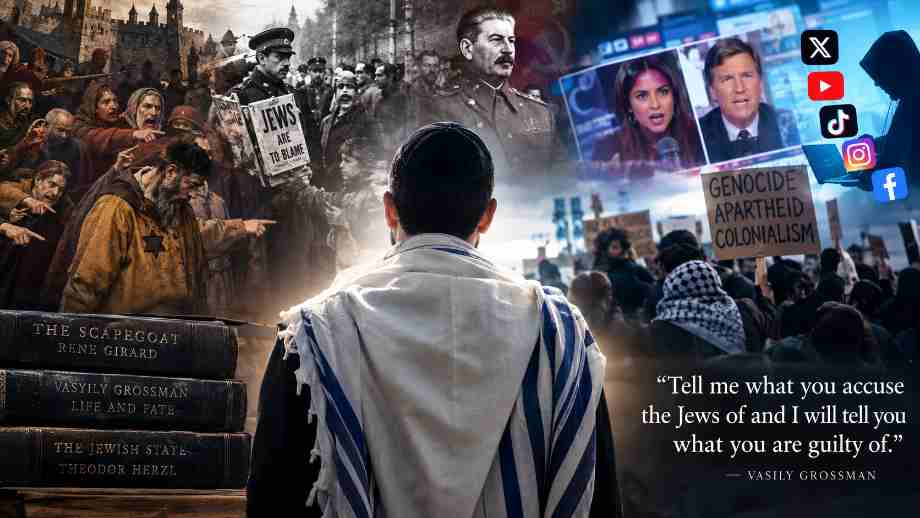 Click Image to Enlarge. Image created via AI.
History provides a grim ledger of empires that attempted to manage their internal mortality by projecting their guilt onto their Jewish populations—only to accelerate their own demise.
The Mechanics of the anti Jewish Mob and French Philosopher René Girard’s Scapegoat Mechanism
To understand why the Jewish people are continually held accountable for the crises of their host nations, one must look to the French philosopher René Girard. Girard’s core thesis centers on mimetic desire—the idea that humans do not generate their own desires independently; they copy what others want. This constant imitation inevitably breeds intense societal rivalry, anxiety, and uncontained internal chaos. [1, 2, 3, 4]
When a community or civilization reaches a boiling point of internal failure, it requires a relief valve to prevent total self-destruction. Girard identified the scapegoat mechanism as society’s ancient, recurring trick to bleed off this pressure. A specific, highly visible minority group [The Jews] is singled out and blamed for the structural collapse or collective anxiety of the majority. [1, 2, 3, 4, 5]
Crucially, Girard noted that the mechanism only works if the persecutors sincerely believe in the guilt of the victim. The unanimity of the shouting crowd becomes its own absolute proof. By expelling or punishing the scapegoat, the community experiences a false, fleeting sense of psychological purification and peace—all while entirely avoiding the painful reality of their own moral rot. [1, 2, 3]
The Fourteenth-Century Black Death
Girard famously opens his foundational work, The Scapegoat, by analyzing a 14th-century poem detailing the arrival of the bubonic plague in Europe. Rather than confronting the systemic failures of medieval infrastructure, sanitation, or theological paralysis, European societies defaulted to the scapegoat mechanism[the Jew]. They fabricated the myth that Jewish communities were poisoning the water wells. The subsequent massacres and expulsions of Jewish populations did nothing to halt the plague, but they permanently devastated the economic and social fabric of the regions that partook in the violence. [1, 2]
The Twilight of Tsarist Russia
In the late 19th and early 20th centuries, the Romanov dynasty faced imminent collapse due to systemic corruption, industrial stagnation, and widespread peasant poverty. To redirect the revolutionary fury of the masses, the Tsarist regime actively sponsored violent anti-Jewish pogroms and manufactured The Protocols of the Elders of Zion—a fabricated blueprint of global domination. By pointing the finger outward at the Jewish population, the autocracy blinded itself to its own internal rot. The scapegoating failed to save the empire, which collapsed into the fires of the Bolshevik Revolution .
The Final Paranoia of Stalinism
In the winter of 1952–1953, a dying Joseph Stalin orchestrated the infamous “Doctors’ Plot,” accusing a group of predominantly Jewish physicians of plotting to assassinate Soviet leadership. State media exploded with vitriolic antisemitic propaganda, and plans were laid for mass deportations. This frantic search for an internal [Jewish ]enemy exposed the absolute moral bankruptcy of the totalitarian state. Stalin’s sudden death in March 1953 halted the purge, but the episode highlighted how a crumbling regime will use antisemitism as its ultimate, desperate weapon of mass distraction. [1, 2, 3, 4, 5]
The Literary Mirror: Vasily Grossman’s Verdict on Antisemitism
No writer captured the psychological mechanics of this phenomenon with greater lucidity than the Soviet-Jewish journalist and novelist Vasily Grossman. Having spent 1,000 days on the front lines of World War II reporting on the Eastern Front, Grossman was one of the first to document the realities of the Holocaust. His mother was murdered in the Berdychiv massacre, a tragedy that fundamentally reawakened his secular Jewish consciousness. [1, 2, 3]
In his banned masterpiece, Life and Fate, Grossman explicitly analyzes antisemitism not merely as a localized prejudice, but as a diagnostic tool for measuring the decline of a society. He wrote the definitive philosophical indictment of the accuser: [1, 2, 3]
“Tell me what you accuse the Jews of and I will tell you what you are guilty of.” [1]
Grossman demonstrated that antisemitism is a perfect mirror of human and state inadequacy.
In his extensive reporting and public lectures following the October 7 attacks, the British author and journalist Douglas Murray has frequently anchored his analysis of modern anti-Israel fury in this very quote. Murray has worked to reintroduce Vasily Grossman’s law from Life and Fate to the modern lexicon, pointing out that the hyper-obsessive, coordinated moral indictments leveled against the Jewish state function as textbook psychological projection. When analyzing contemporary geopolitics through Murray’s application of the Grossman verdict, the external accusations transform into live, public confessions of the accusers’ own moral and structural realities:
The Genocidal Accusation:
Murray explicitly argues that the contemporary mobs loudly accusing Israel of “genocide” are frequently the very voices defending, rationalizing, or actively desiring the actual genocidal erasure of the Jewish state .
The Imperial and Colonial Smear: When international regimes lecture Israel, the mirror reflects their own systemic actions. As Murray notes, when the Iranian regime condemns Israeli “colonialism,” it does so to distract from the reality that the mullahs have colonized and destabilized Yemen, Syria, Iraq, and Lebanon. Similarly, when Turkish President Erdo?an decries Israeli “occupation,” he projects away from the fact that Turkey has illegally occupied northern Cyprus for over half a century.
The illiteracy of the mob :
Following the destruction of the Second Temple in 70 CE, the [European] Roman Empire aggressively colonized Judea, taking roughly 97,000 Judeans captive to Europe as slaves who were forced into grueling labor and scattered across a two-millennium diaspora. To survive this exile, the displaced Jewish people channeled the spirit of Jeremiah, the weeping prophet—who originally lamented the destruction of Jerusalem while fiercely predicting a return to its borders—by embedding a foundational framework of hope into their daily survival. This unyielding longing for Zion culminated in the medieval liturgical pledge, “Next Year in Jerusalem,” a definitive declaration used at the close of every Passover Seder and Yom Kippur to actively assert that their history was not closed and that ultimate liberation meant a physical return to their stolen homeland.
Western Atone-by-Proxy Grift:
In Western academic and digital spaces, Murray observes a desperate “cosplay revolutionary” subculture. Activists burdened by their own societies’ historical guilt regarding colonialism, slavery, and imperial genocide try to clean their own moral slate by projecting those exact historical sins onto the modern Jew. By weaponizing these absolute moral indictments, the accuser seeks a quick hit of digital or political absolution. Yet, as Murray’s analysis reinforces, the strategy ultimately fails to conceal the underlying truth: the louder the public outcry against the scapegoat, the deeper the moral bankruptcy and inadequacy of the one pointing the finger.
If an empire is economically stagnant, it accuses the Jews of financial manipulation. If a regime is violently authoritarian, it accuses the Jews of plotting subversion or espionage. If a society is fracturing culturally, it claims the Jews are poisoning its values. [1]
Through Grossman’s literary lens, the accusation leveled against the Jewish collective is never actually about the actions of the Jew; it is always an inadvertent, public confession of the crimes, failures, and deep-seated insecurities of the accuser. [1, 2]
The Birth of the “Intellectual”
Before the Dreyfus Affair, Theodor Herzl was an assimilated, secular Austro-Hungarian journalist and playwright. He was a cosmopolitan intellectual who believed the solution to antisemitism was complete Jewish integration and cultural assimilation into European society.
In 1894, Herzl was sent to Paris by his newspaper, the Neue Freie Presse, to cover the trial of Alfred Dreyfus. He did not just witness a courtroom proceeding; he witnessed the total collapse of Western liberalism. What shattered Herzl’s worldview was not the actions of the corrupt military tribunal, but the reaction of the French public. Paris was the global capital of enlightenment, liberty, and human rights—yet Herzl stood in the streets and heard massive, educated crowds chanting, “Death to the Jews!” (not just “Death to the Traitor”).
Herzl realized a profound truth that aligned perfectly with the Girardian scapegoat mechanism: assimilation would never be enough. No matter how cultured, patriotic, or integrated a Jew became, the surrounding society would always retain the option to pull the rug and activate the scapegoat protocol in times of crisis.This psychological shock directly inspired Herzl to write his foundational pamphlet, Der Judenstaat (The Jewish State), published in 1896. He concluded that the only permanent answer to the “incurable accusation” was for the Jewish people to exit the cycle of European scapegoating entirely and re-establish their own sovereign state.
The Dreyfus Affair was the direct catalyst that transformed Zionism from a fringe ideological concept into a modern political movement.
A fascinating and often overlooked byproduct of the Dreyfus Affair is that it literally gave birth to the modern noun “intellectual.” Before 1898, the word [intellectual ] existed only as an adjective.
Following the publication of Émile Zola’s J’accuse…!, a wave of prominent French writers, scientists, and artists signed public petitions protesting Dreyfus’s imprisonment and demanding a new trial. In a bitter attempt to dismiss these public figures, the anti-Dreyfusard, right-wing journalist Maurice Barrès wrote a scathing critique in which he used the word “intellectuals” as a pejorative insult. He weaponized the term to mock these professors and writers, characterizing them as arrogant, out-of-touch elites who dared to challenge the sacred authority of the military and the state on the basis of abstract concepts like “truth” and “justice.”Zola and his allies, including the future Prime Minister Georges Clemenceau, proudly adopted the insult as a badge of honor.
The term was rapidly re-defined to mean exactly what Zola had done: The “intellectual ” was a thinker who steps out of their ivory tower to use their cultural authority to speak truth to power and disrupt a scapegoating mob.
In modern political discourse, the ghost of J’accuse is regularly invoked whenever public figures attempt to cut through institutional gaslighting or systemic projection. However, modern geopolitical adaptations show that the phrase is now weaponized by all sides of global conflicts, frequently mirroring the very anxieties Grossman diagnosed:
In contemporary debates at the United Nations or the International Court of Justice (ICJ), the rhetoric of J’accuse is frequently deployed. Human rights organizations often publish reports framed around the ethos of Zola, aiming to systematically dismantle state narratives regarding geopolitical conflicts. True to Vasily Grossman’s verdict (“what you accuse them of is what you are guilty of”), contemporary global conflicts often feature a phenomenon of hyper-accusation.
Nations and political factions regularly launch preemptive, totalizing moral indictments against their adversaries—accusing them of crimes against humanity or state-sponsored subversion. In many cases, these absolute moral declarations are designed to shield the accuser from scrutiny regarding their own internal authoritarianism or domestic failures.
The lasting legacy of Zola’s cry is that it established a precedent: a single voice, armed with meticulous facts and moral clarity, can successfully halt the momentum of an entire society determined to blame its sins on a convenient scapegoat.
The fundamental tension between the outward-facing accuser and the inward-facing reality of Torah agency exposes a profound moral asymmetry in how society handles crisis. Driven by mimetic rivalry, the accuser relies on the scapegoat mechanism, projecting a community’s accumulated tension and guilt onto a visible target to completely avoid self-reflection.
In sharp contrast, Torah agency is rooted in absolute moral accountability, forcing both the individual and the collective to look inward to rectify the self through Teshuvah. This divergence directly dictates historical survival: while predatory empires like Tsarist Russia or the Stalinist USSR blinded themselves to their own internal rot and accelerated their own collapse, the framework of ethical permanence within Judaism allowed its culture to outlive its historical persecutors.
Ultimately, this dynamic validates the Grossman verdict; the nature of the external accusation serves as a public confession of what the accuser is actually guilty of committing, leaving the targeted collective to bear the heavy burden of the world’s projected moral crises.
The Current Manifestation: The Post-October 7 Global Stage and the 15-Minute Grift
The ultimate evolution of this historical pipeline is its hyper-modern manifestation: the monetization and digital amplification of international antisemitism following the October 7 attacks. In the contemporary attention economy, the ancient scapegoat mechanism has been fused with algorithmic monetization. The modern accuser no longer requires an imperial decree or a printed Protocols of the Elders of Zion; instead, they leverage digital platforms to “grift off the Jews” for their literal and figurative 15 minutes of fame.
Antisemitism has become a highly lucrative commodification strategy. Podcasters, commentators, and social media influencers with no baseline historical knowledge routinely orchestrate bad-faith provocations, banking on a brief cycle of outrage to monetize views, build subscriber bases, and solicit donations. The targeted harassment of the Jewish collective is transformed into short-form content designed entirely for financial self-interest and cultural capital.
This structural dynamic manifests across several key domains:
Algorithmic Mimetic Rivalry
In the wake of October 7, global anxieties erupted. Rather than confronting complex geopolitical realities or deep-seated regional fractures, content creators, political opportunists, and digital grifters instantly activated the Girardian relief valve. They discovered that generating extreme, conspiratorial anti-Jewish rhetoric guarantees immediate, explosive algorithmic engagement.
The Modern Verification of Grossman’s Mirror
Every digital accusation leveled on the post-October 7 landscape continues to reflect Grossman’s definitive law.
The modern grifters who accuse the global Jewish community of unseen manipulation, systemic malice, or moral bankruptcy are invariably projecting their own moral deficits outward.
Their performance of public outrage acts as an inadvertent confession of their own intellectual shallowing, ethical compromise, and desperate hunger for temporary digital relevance.Just as the medieval masses blamed the well-poisoners and the Tsarist autocrats blamed the “Elders,” the modern digital mob uses the Jewish people as a lightning rod for broader civilizational fractures—proving that while the mediums of transmission change from pamphlets to platforms, the mechanics of the incurable accusation remain identical.
Today, Vasily Grossman’s profound diagnostic tool is playing out in real time across our digital feeds, acting as a live thermometer for a fracturing global order. The instant a nation, political movement, or online community faces internal failure, economic despair, or moral paralysis, the algorithmic machinery activates the scapegoat mechanism almost instantaneously.
We see this live-streamed whenever a Western society experiences soaring housing costs or inflation; rather than confronting complex economic policies, digital grifters instantly trend conspiracy theories blaming Jewish financial networks. When authoritarian regimes or highly polarized political factions suffer internal instability, they launch coordinated state-media campaigns accusing Jewish organizations of espionage, foreign subversion, and orchestrating domestic unrest.
Simultaneously, as modern culture fractures along deep ideological fault lines, influencers on both the extreme left and right live-stream accusations that the Jewish community is actively “poisoning” societal values—whether they frame it as a threat to traditional nationalism or an impediment to progressive social justice. In every viral clip and monetized tweet, the accusation remains an inadvertent, real-time confession of the accuser’s own intellectual bankruptcy and desperate inadequacy. The Counterfeit: Anti-Semitic Grifters Touting True Authority
In stark contrast to this noble historical lineage, today’s digital media landscape features a distinct cohort of high-profile commentators who aggressively brand themselves as counter-cultural “intellectuals” fighting the establishment. In practice, research and civil rights organizations characterize them as digital grifters who exploit the ancient scapegoat mechanism for financial gain and personal brand inflation.
Rather than stepping out to disrupt a mob on behalf of truth, these figures actively manufacture and feed the mob by mainstreaming antisemitic conspiracy theories, historical revisionism, and geopolitical disinformation under the guise of intellectual bravery:
The 1990 film The Grifters operates as a perfect allegorical mirror for the modern media landscape occupied by figures like Tucker Carlson and Candace Owens. Dissecting the narrative of the movie alongside contemporary political commentary, the behavioral parallels between Jim Thompson’s fictional swindlers and these digital media figures become unmistakable: [1]
Tucker Carlson:
The independent broadcaster frequently utilizes a calculated rhetorical strategy of “just asking questions” to strip away traditional journalistic guardrails. By providing uncritical platforms to Holocaust revisionists like Darryl Cooper or white nationalists like Nick Fuentes, he leverages his massive cultural reach to repackage fringe, anti-Jewish conspiracy theories as respectable alternative history for a mass audience.
Candace Owens:
Following her departure from mainstream alternative media, her content pivoted into direct antisemitism. Research by the Jewish People Policy Institute [JPPI] found that the overwhelming majority of her content referencing Jewish people relied on classic antisemitic tropes—ranging from bizarre claims about the “transatlantic slave trade “to recycled blood libels and allegations of global cabal control.
The historical illiteracy regarding the historic transatlantic slave trade is the Arab slave trade that produced a glaring cultural contradiction where the largest demographic of religious conversions inside the American correctional system consists of Black inmates.
Seeking a path away from systemic domestic racism and historical American white supremacy, many incarcerated Black men turn to Islam as an alternative spiritual geography and how Islam is the “natural religion of the Black man” and a historical shield against oppression.
In doing so, converts adopt a religious and linguistic system that historically spearheaded a 1,300-year East African slave trade that castrated male captives to prevent reproduction. The ultimate historical irony is choosing to escape the legacy of Western slavery by converting to a system whose core language historically used—and continues to use—the word for slave (Abeed) as the standard colloquial term for a Black person.[1]
Nick Fuentes:
A prominent white nationalist commentator who relies on a veneer of pseudo-intellectual political philosophy to radicalize younger online audiences. He openly utilizes his platform to launch explicit attacks on “organized Jewry,” praise historic totalitarian dictators, and orchestrate systematic Holocaust denial.
Dan Bilzerian:
A social media personality who pivoted into the political manosphere, using his platform to spread explicit antisemitic conspiracy theories and recycled tropes about Jewish power to monetize a highly engaged, receptive digital audience.
Lucas Gage:
A far-right online influencer who heavily amplified his digital footprint post-October 7 by shifting from standard internet trolling to relentless, explicit messaging regarding “Jewish supremacy,” actively encouraging the targeted harassment of Jewish communities online.
Hasan Piker:
Operating on the far-left of the digital spectrum, this prominent Twitch streamer has faced severe bipartisan congressional condemnation for utilizing a pseudo-intellectual, anti-imperialist framework to rationalize October 7 terrorism, downplay atrocities, and promote hostile rhetoric targeting Orthodox Jews.
The ultimate paradox of the Torah Agency remains absolute.
The foundational architectures of Islam and Christianity reveal a striking structural dependency: they are fundamentally built upon the narrative, prophetic, and covenantal bedrock of the Hebrew Bible. While Judaism stands entirely on its own historical and philosophical merit, the daughter religions structurally fracture when the original rug of Judaism is pulled out from under them. Yet, the ultimate paradox of Torah agency remains absolute. While the surrounding world continually reaches for the external scapegoat to absolve itself of its own moral debts, the Jewish tradition insists on an arduous, internal ethical accounting.
It is this profound structural asymmetry that explains both the world’s recurring, algorithmic fixation on holding the collective Jewish race accountable for civilizational failures, and the enduring miracle of a people who have continuously outlived the very empires that tried to make them their cross. [1]
Israpundit is entirely dependent on readers support. Please help me continue educating people with the truth about what is going on in Israel and around the world.


Leave a Reply
You must be logged in to post a comment.