
Harry Liberman
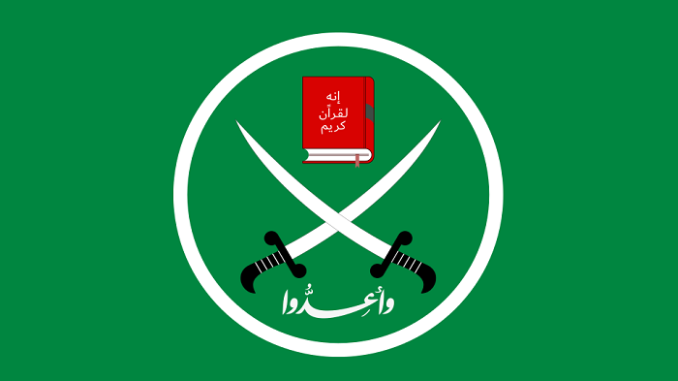 Muslim Brotherhood Flag. Phaoto: Public Domain, Wikimedia Commons
Jasem Aljuraid is a Kuwaiti investigative journalist, political analyst, and prominent dissident based in Canada. Formerly a Senior Vice President at the Kuwait Financial Centre (Markaz) and a writer for the Al-Qabas newspaper, he was forced into exile after facing death threats and legal persecution for his public advocacy of regional peace, normalization with Israel, and his vocal opposition to sectarian extremism. [1, 2]
Career and Exile
- Journalism and Corporate Leadership: Aljuraid wrote extensively for the Kuwaiti daily Al-Qabas for nearly a decade and served as an executive at the Kuwait Financial Centre. [1, 2]
- Activism: He emerged as a vocal advocate for secular, law-based governance in the Middle East. He fiercely opposes radical Islamist groups, including the Muslim Brotherhood and Salafi networks. [1]
- Turning Point: His life shifted drastically in 2022 when he interacted with an Israeli journalist on social media, referring to him as a “friend”. This triggered severe public backlash, a boycott campaign, and his dismissal from Al-Qabas. Facing a prison sentence and death threats, he fled Kuwait and sought asylum in Canada, where he lives as a protected person. [1, 2, 3]
United Nations Address
Aljuraid gained international attention for an address he delivered at the United Nations Human Rights Council (UNHRC) in Geneva. Representing United Nations Watch, he spoke on the topic of “colonization” and challenged the council’s frequent condemnation of Israel. [1, 2]
https://unwatch.org/who-are-the-real-colonizers-arab-refugee-stuns-u-n-human-rights-council/
He highlighted the historical presence of Jewish kingdoms in Judea and argued that it was the Arab expansion that historically Arabized the region, a speech that made headlines as a rare perspective from an Arab dissident on the international stage. [1, 2, 3]
https://www.youtube.com/watch?v=HXqmMsIXgZc
- Aljuraid continues his analytical and investigative writing from Canada, focusing on Middle Eastern geopolitics, human rights, and exposing ideological networks of extremism. [1]
- Following his mother’s passing, he announced the launch of an independent watchdog to cover politics, business, and human rights across the Middle East, North Africa, and Turkey. [1]
- Learn more about his advocacy and geopolitical commentary through the Ideological Defense Institute.[1]
The Muslim Brotherhood operates less like a standard political movement and more like a religious mafia, enforcing a modern-day omertà where exit means death.
The Blood Allegiance
At the core of the Muslim Brotherhood is the bay’ah—an absolute oath of obedience to the Supreme Guide. While framed as a religious duty, this pledge functions exactly like a mafia initiation ceremony. Initiates do not just join a cause; they surrender their autonomy to a secret hierarchy. In their ideological framework, breaking this oath is not viewed as a political disagreement. It is branded as apostasy and high treason, crimes traditionally met with a death sentence.
Enforcing the Modern Omertà
Like a criminal cartel, the Brotherhood treats defectors and informants as existential threats. The group’s survival relies on a strict code of silence and absolute conformity. By twisting the concept of Islamic loyalty into a tool of organized coercion, the leadership ensures that the cost of betrayal is paid in blood. This fusion of religious zealotry and mob-style enforcement transforms a spiritual identity into a permanent, inescapable trap.
High-profile defections from the Muslim Brotherhood illustrate how the organization treats departure as high treason, often responding with character assassination, isolation, or violence. Prominent examples of defectors who faced severe retaliation include: [1]
1. Sayyid Fayez (1953)
Sayyid Fayez was a prominent leader within the Brotherhood’s clandestine militant wing, the Secret Apparatus. In the early 1950s, Fayez attempted to reform the group from within and distance it from rogue terrorism, cooperating with Egyptian police to rein in rogue factions. In retaliation for his perceived betrayal, members of the Secret Apparatus sent him a gift box of sweets for a religious holiday that was rigged with explosives. The bomb detonated, killing Fayez and his brother. [1, 2]
2. Tharwat El-Kherbawy
A prominent Egyptian lawyer, Tharwat El-Kherbawy defected from the Brotherhood in 2002 after discovering widespread financial corruption and deep ideological hypocrisy.
- The Retaliation: The Brotherhood immediately launched a massive smear campaign, branding him a traitor, an apostate, and a state spy to destroy his professional reputation.[1, 2, 3]
- The Exposure: El-Kherbawy went on to write the bestselling exposé The Heart of the Brotherhood, where he explicitly compared the inner workings, blood oaths, and total isolation of the group to the Sicilian Mafia.
3. Abdel Moneim Aboul Fotouh (2011)<
Abdel Moneim Aboul Fotouh was a highly popular, reform-minded member of the Brotherhood’s top leadership guidance bureau. In 2011, he broke ranks to run for the Egyptian presidency independently, violating the group’s strict collective mandate. [1, 2]
- The Retaliation: The leadership formally expelled him, declared his candidacy a sin, and weaponized their base to socially boycott and threaten him. [1]
- The Outcome: Though he tried to form a moderate political alternative, he was caught in the crossfire of the group’s toxic legacy. He was eventually imprisoned by the state in 2018 under charges related to political unrest. [1]
4. Khaled Dawoud and the 2011 Youth Wave
Following the 2011 Egyptian revolution, hundreds of younger members defected to form independent, democratic political groups like the Riyada Party. The Brotherhood’s response followed standard cartel tactics: elders issued fatwas questioning the youths’ Islamic faith, cut off family financial networks, and systematically blacklisted the defectors from Islamist-run charities, businesses, and professional syndicates to force them into financial ruin. [1, 2, 3]
The Muslim Brotherhood represents an existential threat far outstripping traditional organized crime. While the Mafia targets local coffers, this global Islamist syndicate aims for the cultural and political bedrock of Western civilization. Operating behind a carefully curated facade of charitable outreach and political activism, the Brotherhood has successfully embedded itself within the social fabric of the United States and Europe, executing a subversion strategy that no criminal cartel could ever dream of achieving.
The tragic irony lies in the West’s legal double standard.
- Council of European Muslims (CEM): Formerly known as the Federation of Islamic Organisations in Europe (FIOE), this Brussels-based group serves as the overarching European umbrella network. European intelligence agencies have identified it as the primary organ coordinating Brotherhood-aligned operations across the continent. [, 2, 3]
- Deutsche Muslimische Gemeinschaft (DMG): Based in Germany, the DMG (formerly the Islamic Community in Germany) is recognized by German domestic intelligence services as the primary representative body of the Brotherhood in the country. Its historical hub, the Islamisches Zentrum München (IZM), served as a foundational base for the Brotherhood’s European operations for decades.[1]
- Musulmans de France (MF): Formerly known as the Union of Islamic Organisations of France (UOIF), this massive network controls numerous mosques and cultural centers. French authorities have frequently flagged it as a primary platform driving ideological segregation and radicalization. [1, 2]
- Muslim Association of Britain (MAB): Founded by senior Brotherhood figures, the MAB operates openly in the United Kingdom. Parliamentary and security reviews have highlighted its deep ideological affinity with the Brotherhood. [1, 2]
- Islamic Relief Worldwide (IRW): Headquartered in the UK, this international charity has faced severe scrutiny. Countries like Germany, Israel, and the United Arab Emirates have restricted its operations or accused its leadership of maintaining close financial and structural ties to both the Brotherhood and its militant Palestinian offshoot, Hamas. [1, 2, 3]
- The Holy Land Foundation Precedent: The clearest legal mapping of the Brotherhood’s US network occurred during the 2008 Holy Land Foundation trial, the largest terrorism-financing prosecution in US history. Federal prosecutors submitted internal Brotherhood documents, including a strategic memo detailing a “civilization-jihadist process” aimed at undermining Western institutions from within. The trial officially designated several major US Muslim civil society groups as unindicted co-conspirators due to their foundational ties to the Brotherhood’s leadership network. [1]
- Islamic Society of North America (ISNA): Identified in federal records as one of the primary umbrella organizations established by Brotherhood members in the 1980s to manage property and influence across American mosques.
- Muslim Students Association (MSA): Established on US college campuses in the 1960s, the MSA was the foundational stepping stone for the global Brotherhood’s entry into North America, serving as a primary recruitment and networking tool. [1]
- Council on American-Islamic Relations (CAIR): Though operating today as a prominent civil rights organization, CAIR was explicitly listed as an unindicted co-conspirator in the Holy Land Foundation trial. Federal investigators traced its origins back to the Palestine Committee, a secret cell created by the global Brotherhood to coordinate political influence and financial support within the United States.
- American Muslims for Palestine (AMP): More recent counterterrorism research and congressional hearings have flagged AMP as a contemporary front, alleging it relies on overlapping leadership and funding networks historically tied to the Brotherhood’s support apparatus. [1]
- Political Alignments: The Labour Party has historically faced the most intense scrutiny for local engagement with Brotherhood-linked groups. In the 2000s and 2010s, prominent Labour figures and local councils frequently collaborated with the Muslim Council of Britain (MCB) and the Muslim Association of Britain (MAB) on community cohesion initiatives, despite counterterrorism reviews highlighting their ideological links to the Brotherhood. [1, 2]
- The Civil Service: Security analysts have repeatedly warned about Islamist entryism within the British civil service, particularly within departments handling integration and community outreach, where Brotherhood-aligned actors have influenced public policy. [1]
- The Shift: British tolerance has deteriorated heavily. Growing concerns over campus radicalization and foreign pressure have forced a pivot. Political parties like Reform UK have openly campaigned to completely ban the Muslim Brotherhood, while the broader British government has tightened definitions of extremism to cut off state engagement with these front organizations. [1, 2, 3]
- Political Alignments: Germany’s Social Democratic Party (SPD) and The Greens (Die Grünen) have historically been the most susceptible to partnering with Brotherhood affiliates under the banners of integration, multiculturalism, and anti-discrimination initiatives. Local chapters of these political parties have frequently invited DMG-affiliated figures to sit on municipal integration councils.
- The Pivot: Germany’s domestic intelligence agency, the Verfassungsschutz, has become highly aggressive in tracking the Brotherhood. Intelligence reports explicitly warn German political elites that collaborating with these groups legitimizes a “legalistic Islamist” agenda that quietly undermines democratic social cohesion while keeping an outwardly peaceful appearance. [1, 2, 3]
- The Internal Message: Within Arabic-language media and their own foundational documents, their stated goal is an unyielding religious war (jihad) to destroy Israel and establish an Islamist caliphate.
- The Western Message: When operating within the broader “Free Palestine” movement in the West, Brotherhood-linked front groups systematically strip out all religious and Islamist terminology. They translate their agenda into the language of the Western political left, using terms like “national liberation,” “anti-colonialism,” “human rights,” “social justice,” and “intersectionality.” By adopting this vocabulary, a radical religious movement successfully launders itself as a progressive social justice cause.
- The Hamas Connection: Hamas was founded in 1987 explicitly as the Palestinian wing of the Muslim Brotherhood.
- The Western Fronts: In the United States and Europe, groups like American Muslims for Palestine (AMP) and various student coalitions organize campus protests, rallies, and boycott campaigns. Counterterrorism analysts and legal investigations have repeatedly shown that the leadership, board members, and founding donors of these pro-Palestinian groups heavily overlap with the infrastructure of defunct Brotherhood fronts (such as those exposed in the 2008 Holy Land Foundation trial). The “Free Palestine” movement allows these individuals to operate in mainstream politics without the toxic baggage of the Brotherhood name.
- By positioning the Palestinian cause as the ultimate litmus test for progressive activism, Brotherhood-linked organizers draw in secular student groups, LGBTQ+ organizations, climate activists, and left-wing political parties.
- These Western activists provide the Brotherhood’s agenda with mainstream legitimacy and a shield of political correctness. Anyone who criticizes the organizers or exposes their Brotherhood ties is immediately accused of “Islamophobia” or attacking the broader human rights movement.
- The Mechanism: Large-scale humanitarian crowdsourcing campaigns and multi-million dollar non-profit networks collect funds under the banner of “Gaza Relief” or “Palestine Aid.”
- The Diversion: Because these organizations operate under the umbrella of legitimate humanitarian relief, they can obscure the ultimate destination of the funds. Financial intelligence reports have repeatedly flagged how radical actors exploit these massive, decentralized pro-Palestinian funding streams to funnel capital back into networks controlled by Brotherhood affiliates and Hamas operatives, effectively laundering illicit political financing through mainstream charity.
- The Propaganda Blueprint: The lawsuit alleges that immediately following October 7, NSJP distributed a highly detailed “Day of Resistance Toolkit.” This document instructed student chapters across the United States to act as “foot soldiers” and “collaborators and propagandists” for Hamas. It framed the slaughter, rape, and kidnapping of civilians not as terrorism, but as a “legitimate” and “necessary” act of national liberation. [1, 2, 3]
- The Corporate Connection: The suit explicitly notes that AMP was formed from the ashes of the Islamic Association for Palestine (IAP), a defunct group that was shuttered by federal authorities for criminally financing Hamas. The lawsuit alleges that AMP and NSJP essentially acted as the “unauthorized public relations and material support division” for Hamas inside the United States, utilizing the broader Free Palestine campus movement as their laundering vehicle. [1, 2, 3]
- Virginia Attorney General Investigation: Virginia’s Attorney General launched a formal investigation into AMP, citing evidence that the organization was soliciting millions in donations under the guise of general Palestinian humanitarian aid while funneling those resources toward unauthorized, illicit political purposes linked to foreign terrorist networks. [1]
- The Texas Legal Filing (January 2026): Texas Attorney General Ken Paxton filed legal briefs against AMP and other radical networks. The filings directly accused these organizations of exploiting the post-October 7 political landscape to launder the image of Hamas, leveraging millions in untraceable dark money raised via campus activism to advance the broader geopolitical goals of the global Muslim Brotherhood network. [1]
- The MSA Network: Founded in the U.S. in the 1960s by Muslim Brotherhood members, the MSA has actively disseminated the group’s foundational ideology across North American campuses for decades. Security analysts have testified that the MSA essentially acts as an operational stepping stone for the group’s network. [1]
- Foreign Funding Laundering: Billion-dollar, unreported donation streams—predominantly originating from Qatar—fund specific Middle Eastern studies departments, academic chairs, and student fellowships. This funding directly incentivizes university administrations to tolerate radical anti-Western and anti-Israel campus groups. [1, 2, 3]
- The Post-October 7 Mobilization: Following the October 7, 2023 massacres, the rapid coordination of aggressive campus encampments and blockades was traced back to National Students for Justice in Palestine (NSJP). Congressional and legal filings show that NSJP Distributed a “Day of Resistance Toolkit” that directly parroted the rhetoric of Hamas—the official Palestinian wing of the Muslim Brotherhood. [1, 2]
- Operational Control: Columbia was the ground-zero launchpad for the 2024 encampments, where radicalized student groups occupied academic buildings and explicitly voiced support for Hamas.
- Administrative Complicity: Columbia’s leadership faced multiple congressional hearings for failing to protect Jewish students, allowing pro-Hamas elements to establish an aggressive parallel authority on university grounds. [1]
- The Harvard Comparison: While Harvard University faced immense global scrutiny and the resignation of its president over campus antisemitism, academic watchdogs note that Harvard’s institutional issues stem heavily from a broad, left-wing “victimhood culture”. In contrast, Columbia features active, deeply embedded cells directly collaborating with foreign radical networks. [1]
- York University: In the immediate wake of October 7, three of York’s main student unions issued statements explicitly praising the terrorist massacres as a “legitimate form of resistance,” forcing the university to threaten a total revocation of their union status. York has faced massive class-action lawsuits over a “poisoned, lawless environment” where radical mobs targeted students. [1, 2, 3, 4, 5]
- Concordia University: Concordia has a decades-long history of violent campus radicalism (notably the 2002 Netanyahu riot). Post-October 7, it became a primary hub for aggressive, mob-style anti-Israel blockades, heavily driven by local MSA and SJP elements acting under the banner of the broader Free Palestine movement. [1]
- University of Toronto: U of T allowed an unauthorized encampment to occupy King’s College Circle for over 60 days before finally seeking a court injunction for trespass. Medical residents and researchers at U of T have filed legal complaints documenting a systemic, institutional bias where open support for terrorism was treated by faculty as protected speech. [1, 2, 3, 4, 5]
- McGill University: McGill’s campus was heavily destabilized by aggressive blockades that forced the closure of entire academic buildings. The administration ultimately had to resort to hiring private security firms to dismantle the encampments after local police bodies hesitated to intervene. [1, 2]
| University [1, 2, 3, 4, 5, 6, 7, 8] | Country | Freedom of Expression/Safety Grade | Primary Driver of Radicalization |
|---|---|---|---|
| Columbia University | United States | F / Critically Unsafe | Direct operational coordination with NSJP; heavy foreign funding networks. |
| York University | Canada | F | Student union captured by pro-Hamas radicals; active harassment of minorities. |
| Concordia University | Canada | F | Deeply rooted activist history; violent campus blockades and intimidation. |
| Harvard University | United States | D- | Progresive ideological capture and institutional paralysis by administrators. |
| University of Toronto | Canada | F | Institutional appeasement; 60+ day radical trespass encampment. |
- University of Georgia (UGA): One of the absolute first documented campus rallies took place on October 8, 2023, organized by UGA’s SJP chapter. The group explicitly released statements celebrating the Hamas massacres, declaring that “the Palestinian people, yesterday, fought back successfully” and framing the slaughter of civilians as a “historic win.” [1]
- Columbia University: On October 9, 2023, Columbia’s SJP and Jewish Voice for Peace (JVP) chapters published a joint open letter expressing “full solidarity with Palestinian resistance”. They quickly used their logistical networks to organize a massive campus-wide mobilization by October 12, serving as the blueprint for the wider American university movement. [1]
- City University of New York (CUNY): Multiple CUNY campus groups and activist factions mobilized on October 8 and 9, participating directly in the notorious Times Square rally where attendees and speakers openly celebrated the atrocities. [1, 2, 3]
- Arizona State University (ASU): ASU’s SJP chapter immediately blasted social media graphics and statements on October 8, framing the terror attack as a standardized blueprint for anti-colonial liberation.
- York University (Toronto): On October 8, 2023, three of York University’s primary student unions—completely captured by radical student leadership—released a unified statement praising the massacres. They formally characterized the execution of civilians as a “strong act of resistance,” directly triggering an immediate legal and institutional crisis with the university administration.
- University of Toronto (U of T): The U of T St. George Muslim Students’ Association (MSA), alongside overlapping progressive campus syndicates, drafted and co-signed official statements by October 9, 2023. Their messaging strictly avoided any condemnation of Hamas, instead focusing entirely on condemning the “Israeli regime” and creating institutional resource networks to shield pro-Palestinian student activists. [1, 2]
- McGill University & Concordia University (Montreal): SJP and Solidarity for Palestinian Human Rights (SPHR) chapters at both major Montreal universities issued online manifestos on October 8 and 9, calling the mass casualty event a “historic breakthrough” and summoning students to the streets before the Canadian public had even processed the death toll.
- The Content: This five-page document contained pre-written media statements, graphics explicitly featuring the motorized paragliders used in the massacres, specific protest hashtags, and step-by-step instructions on how to occupy university spaces. [1, 2]
- The Impossibility of Spontaneity: High-level strategic and graphic design assets like the toolkit require days, if not weeks, of administrative drafting, review, and structural alignment. Generating a uniform propaganda campaign for 200 North American chapters within hours of a fluid, unfolding global crisis is structurally impossible without an ongoing, active readiness protocol. [1]
- The Messaging Shift: The messaging was completely uniform across various student groups. They did not wait to react to a humanitarian crisis in Gaza; their very first press releases openly celebrated the method of the attack. [1, 2, 3]
- The Network Structure: The Muslim Brotherhood’s primary legacy organizations, such as the Muslim Students Association (MSA) and the Palestine Committee fronts, provided the financial backing and logistical templates. Because they already had full operational control over local campus syndicates, student government boards, and activist bank accounts, they did not need to organize from scratch. [1]
3. Exploiting Operational Plausible Deniability
Counter-terrorism and intelligence analysts argue that the Brotherhood’s leadership operates with deliberate plausible deniability. While the active student foot soldiers on Western campuses likely did not have the exact date of the operation on their calendars, the regional directors, funding conduits, and network orchestrators maintained a permanent state of high operational readiness.
https://www.hamas-massacre.net/
Israpundit is entirely dependent on readers support. Please help me continue educating people with the truth about what is going on in Israel and around the world.

Any political science program in western universities is far from a joke. They all do the same thing: demonize Israel and evoke a malicious hatred of Jews. If you send your kids to university to study political science, you are paying good money to have your child brainwashed into hating us.