
By Hushang Manuchehri & Walter E. Block
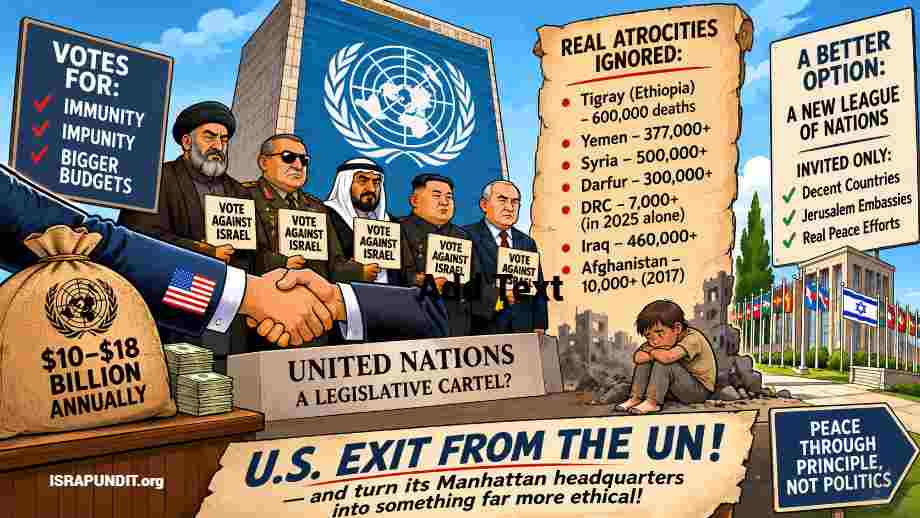 Click Image to Enlarge. Image created via AI.
The United Nations does not operate as an impartial arbiter of global peace; viewed through the cold calculus of Public Choice economics, it functions as a transnational legislative cartel. Sovereign despots, petrostates, and theocratic regimes do not enter the halls of the General Assembly or the Human Rights Council to secure universal human dignity. They arrive to trade within an institutional protection racket.
In classical legislative logrolling, as formulated by James Buchanan and Gordon Tullock, political actors barter votes to secure concentrated private benefits while dispersing costs across the broader public. In the diplomatic bazaar of the United Nations, voting blocs such as the Non-Aligned Movement and the Organization of Islamic Cooperation pool their voting weight to manufacture artificial majorities.
The fiat currency of this trade is the ritualistic, zero-marginal-cost condemnation of Israel. According to systematic tallies compiled by UN Watch, the General Assembly routinely passes more resolutions of condemnation against this lone liberal democracy than against Iran, North Korea, Syria, Russia, and China combined.
Casting an anti-Israel ballot costs an autocrat precisely zero domestic political capital, incurs no trade sanctions, and invites no retaliatory strikes. In exchange, this frictionless diplomatic currency purchases collective immunity for their own domestic atrocities, successfully diverting the world’s institutional machinery away from public hangings in Tehran, torture dungeons in Damascus, and ethnic slaughter in Central Africa.
This legislative extortion is reinforced from within by an entrenched international civil service governed by William Niskanen’s model of budget-maximizing administrative behavior. Administrative agencies do not labor to eliminate the crises that justify their budgets; they maximize headcount, operational scope, and discretionary funding.
In contrast, an international bureaucracy that resolves its underlying conflict effectively votes for its own liquidation. The goal of the American Cancer Society is to rid mankind of this dread disease. That would put it out of business. Ditto for other such legitimate organizations. Not so for that colossus located in Manhattan.
The sprawling UN apparatus and its specialized agencies require the Israeli-Palestinian friction to remain permanently acute and open-ended. By establishing unique bureaucratic perpetuity machines—such as institutionalizing inherited, generationally expanding refugee status under specialized mandates—the UN guarantees the indefinite expansion of its operational footprint. This conflict cannot be allowed to reach equilibrium or fade from diplomatic primacy, because bureaucratic survival demands an inexhaustible supply of moral emergencies to warrant multi-billion-dollar donor appeals and extract guilt-financed capital from Western states.
The grotesque moral distortion born of this institutional incentive structure is laid bare whenever UN leadership postures on the international stage. When Secretary-General António Guterres proclaimed civilian casualties in Gaza to be “unparalleled and unprecedented” during his tenure, the assertion collapsed beneath the weight of basic empirical history.
Ethiopia’s brutal Tigray war, fought entirely under Guterres’s watch, resulted in an estimated 600,000 deaths according to the African Union’s peace envoy and researchers at Ghent University. The UN Development Programme calculated that Yemen’s civil war had amassed over 377,000 fatalities by late 2021. Syria’s industrial slaughterhouse consumed more than half a million lives, Darfur’s genocide claimed over 300,000, and ongoing carnage in the eastern Democratic Republic of the Congo slaughtered over 7,000 people in early 2025 alone. Peer-reviewed studies estimate the Iraq conflict claimed 460,000 lives, while Afghanistan suffered over 10,000 civilian casualties in 2017 alone under the UN’s own monitoring.
Yet none of these genuine catastrophes ever generated a fraction of the UN’s permanent commissions of inquiry, emergency special sessions, or round-the-clock administrative hysteria. Totalitarian slaughterhouses escape scrutiny because trading votes against a democratic, civilized, scapegoat effectively insulates them from accountability.
What should be done, in view of the foregoing? Simple: the US should part company from the UN. The UN building located on the eastside of Manhattan should be converted into something far more ethical. Perhaps it should be devoted to devil worship. On a more serious note, it could be transformed into a successor to the League of Nations into which only decent countries are invited. We could start with nations such as Argentina, Hungary, Micronesia, Nauru, Palau, Papua New Guinea, Tonga, Paraguay, Taiwan, Guatemala, Honduras, El Salvador, Colombia. One litmus test: any country with its embassy in Jerusalem, not Tel Aviv, would be a candidate.
The US pays between $10 and $18 billion to the UN, annually. Surely, this money could be far better spent in almost any direction anyone can name.
Israeli Prime Minister Benjamin Netanyahu spoke at a recent meeting of this august body. New York City Mayor, frustrated that he lacks the power to arrest this hero for “war crimes,” instead called for protests of his appearance. This reeked of incitement. Happily, it came to nothing.
Israpundit is entirely dependent on readers support. Please help me continue educating people with the truth about what is going on in Israel and around the world.


Leave a Reply
You must be logged in to post a comment.