
By Allen Gindler
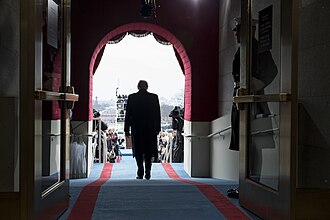 Photo by Shealeah Craighead – President Trump’s First 100 Days: 1, Public Domain, Wikipedia
Donald Trump returned to power promising “America First.” For his devoted supporters in the MAGA movement, this slogan signified a restrained foreign policy, a rejection of unnecessary wars, and a denunciation of the old Republican or neoconservative temptation to control the world. Many of his supporters believed he would be the president who would finally break with interventionist habits, particularly in the Middle East. However, what actually happened was far more complex. Step by step, crisis by crisis, he became deeply involved in nearly every major conflict, and nowhere more than in the Middle East.
Initially, his international involvement was framed as peacekeeping. Trump proudly boasted that he had stopped or defused multiple wars, eight or nine–nobody knows. He clearly wanted the image of a dealmaker who could impose calm where others had failed and get the Nobel Peace Prize in the process. In the Israeli case, however, peacekeeping was never a simple blessing. On the one hand, pressure for pauses and arrangements helped bring some hostages home. On the other hand, those interruptions repeatedly prevented Israel from finishing the job. Hamas was battered but not uprooted. As of today, it has not been disarmed, according to Trump’s plan. It regrouped and preserved enough structure to remain the decisive force on the ground, even if Gaza’s formal administration could be dressed up with technocrats for diplomatic convenience.
The same pattern held in Lebanon. Hizballah was badly mauled and strategically degraded, but it was not erased. It remained alive as a military and political organism, still capable of threatening Israel. What was presented in Washington as deescalation looked from Jerusalem more like strategic interruption. Israel’s enemies were weakened, but not removed. This is an old Israeli tragedy. The war is stopped precisely when victory becomes visible, and then the unfinished enemy returns.
The Iranian front exposed this contradiction even more clearly. When Israel launched its preventive war against Iran several months ago, Trump first seemed to distance himself from it. Then he joined directly and struck Iranian nuclear facilities. He declared those sites obliterated and projected the image of overwhelming force. Yet almost immediately afterward came signs of limitation, caution, and the familiar desire to stop before the logic of war reached its full conclusion. Israel was restrained, and the campaign was narrowed. The message was sent that enough had been done. But in actuality, enough had not been done. Iran’s nuclear ambitions were not truly buried. Its missile threat was not permanently removed. Its regional machinery of terror was damaged, but not broken beyond repair.
It then took months of bitter reality to make the obvious undeniable. Prime Minister Netanyahu had to convince Trump, in effect, that the earlier stopping point had not produced strategic success. It had merely postponed the next necessity. Trump now appears to have accepted that unfinished business must, in fact, be finished. But this time the political cost to him is much greater than before.
Trump is not moving against Iran in a favorable domestic environment. He is doing so while standing on increasingly shaky political ground. Recent polling data on the Iran campaign reveals a deeply divided nation. While President Trump’s core MAGA base largely supports the military strikes (aside from notable dissent among libertarian and isolationist factions) Democrats and Independents predominantly oppose them. Many Americans, particularly outside his base, express confusion regarding the strategic objectives. Substantial portions of the populace, especially non-supporters, voice fears of a protracted conflict, rising gasoline prices, and additional economic burdens. This is not the same as 9/11 of 2001. This is not a moment of national unity around military action. It is rather a moment of fatigue, suspicion, and polarization.
Trump’s ratings have slipped on issues that should have been his strengths. Even immigration, once among his safest issues, no longer gives him the same cushion. The optics of some ICE operations have been poor. His economic message has also lost force. The promised Golden Age has not arrived. Tariffs did not bring immediate prosperity. Liberation Day turned into Liability Day. Prices remain a burden. Voters do not feel the glow of national renewal. In special elections, Democrats have shown energy, while Republicans increasingly talk like a party bracing for losses rather than expecting momentum.
This is why talk of the House slipping away is no longer a fantasy. Even the Senate, while still more difficult for Democrats, can no longer be treated as untouchable. Add to this the continuing Epstein files story, which has refused to disappear from the news cycle, and one sees the full picture. Trump is heading into the second half of his presidency under siege. If Republicans lose one chamber, his remaining years will become an ugly trench war with Democrats, subpoenas, investigations, and almost certainly renewed impeachment efforts. He understands this. His team understands this. And still they have chosen to resume military action against Iran.
That is why this choice has the character of a sacrifice. Whatever his personal motives may be, he is spending political capital he can badly afford to lose. That is not normal political behavior. Most presidents facing this kind of headwind would search for an exit ramp. They would trim objectives, reduce exposure, and buy time. Trump, instead, appears ready to perpetuate division and polarization within society. Trump heard the criticism from within and abroad and proceeded, nevertheless.
Therefore, I view his conduct here as noble; however unusual it may be. I have often criticized Trump for statism, for economic blunders, for unnecessary quarrels with Canada, Mexico, and European allies. But here the moral and civilizational line is clearer than usual. Israel is not fighting a border dispute. It is fighting forces openly committed to its destruction. Iran is not a normal rival power. It is the head of a regional terror octopus whose arms stretch through Gaza, Lebanon, Iraq, Yemen, and beyond. If Trump has concluded that this structure must be uprooted rather than merely managed, then he has chosen good over evil, even at serious personal political cost.
And that is why this moment may define his legacy more than any trade dispute or immigration order ever could. If he stays firm, rejects another premature stop, and truly finishes the business with Iran and its terror satellites, he may reshape the Middle East for a future of greater security and perhaps even mutual prosperity. But if he once again searches for a formula that allows him to declare victory without securing it, then he will suffer the worst of both worlds. He will lose part of his base, inflame his enemies, pay the price of war, and still leave Israel facing the same mortal threat down the road.
In that case, his presidency will indeed be doomed. But if he stands firm, history will remember that when the choice came, Trump was willing to put his presidency on the line for good against evil. This will be his biggest legacy.


Allen Gindler:
I think I could properly be called “MAGA”, since I wholeheartedly support President Trump. I don’t think the other description of MAGA people, the one you provided above, applies to me.
I support Donald Trump, and have always supported him, for only two reasons:
1. He has a heart toward God and His people (the humble), and
2. To as much as he is able, he does what he says.:
I don’t think Trump will lose his presidency, any time soon. I think both he and PM Netanyahu will be killed, probably in summer 2028, and the whole world will rejoice over their deaths. That speaks against the people of the world, not these two good men.
BTW, I am especially glad that Bibi and Trump are fighting side by side.