
By Hugh Fitzgerald |
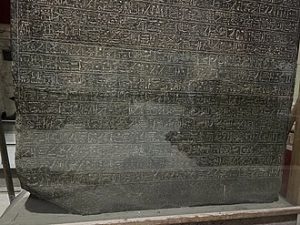 Merneptah Stele at the Cairo Egyptian Museum. By Onceinawhile – Own work, CC BY-SA 4.0, Link
Antisemites are in a permanent state of denial. They deny that there was ever a Holocaust. They deny that Jews have been oppressed through time and space. And now, those who hate the very idea of a Jewish state deny that Jews ever lived in the Land of Israel. But the archeological evidence tells a different story: it is full of mentions of ancient Israel, not only by Jews, but also by Egyptian pharaohs. More on the silent witnesses of the Jews’ connection to their land can be found here.
We live in a world of lies and misrepresentations. Nowhere is this more obvious than in regard to the long history of the Jews. The resurgence of Holocaust denial is now being pared with the denial that Jews ever had a history in the land of Israel. It is as though our whole past has been eradicated.
Even in some Jewish circles, it’s common to hear that the Jewish tradition is based on fantasies, fairytales, and unlikely miracles. It is true that the amount of documentation that has survived over thousands of years is limited. Archaeology is a relatively modern science. Even so, it is important to point out how much of the ancient Jewish tradition has been verified by archaeology, even though there’s a great deal that still remains to be discovered.
The earliest record comes from the Merneptah Stele dated 1028 BCE, which is housed in the new Cairo Museum.
was an Egyptian Pharaoh and a stele (plural: stelae) was a vertical slab of stone or wood, usually rectangular with a rounded top. In the stele, Merneptah records that he conquered “Israel [and] laid it waste and bereft of seed.”…
The Tel Dan Stele was discovered in 1993 and is now in the Israel Museum. In it, the Aram/Damascus King Hazael describes his victory against Ahab King of Israel and Yoram of the House of David. It is the earliest external evidence of the House of David.
After the Babylonian Exile of 586 BCE, the Judeans were able to re-constitute their identity. The Persian king Cyrus conquered Babylon. The famous Cyrus Cylinder (also at the British Museum) tolerated all religions in the Persian Empire, including that of the Jews. He also allowed them to return and rebuild the Temple in Jerusalem. There was opposition from opponents of the Jews, which delayed the work. But Ezra and Nechemia succeeded in the completion of the re-building, thanks to the intervention of Darius the Great. And we have documents from Darius the Second to the Jewish garrison in Elephantine about keeping the Passover and directing the pagan priests to stop harassing the Jews.
Once we get to the Greek and Roman period, the importance and presence of the Jewish communities in Judea and Rome are well documented by both Josephus and other Roman sources. Naturally, the opponents of a Jewish homeland like to deny any of this and claim it is all fake Zionist propaganda. Ironically and in a sign of the times, the British Museum itself pulled an exhibition of Israelite artifacts because they did not want to upset the opponents of the Jewish State.
The cancellation of that exhibition was a shameful episode in self-censorship by the administrators at the British Museum, afraid of offending Muslim Arabs. Possibly it was thought that they would be angered enough to end any financial contribution to the museum, but as a visit to the the British Museum and a reading of its records make clear, by far the greatest contributors to the Museum have been Jews. Among them is the Sir Percival David collection of 10,000 Chinese ceramics, worth more than $1 billion, the Waddesdon Bequest that was bequeathed in 1898 by Baron Ferdinand de Rothschild, an unparalleled collection of nearly 300 Renaissance and medieval pieces, including exquisite jewelry, gold plate, enamels, and micro-carvings; the Hull Grundy gift donated in 1978 by the German-born Jewish philanthropist and art historian Anne Hull Grundy, this gift comprised over 1,200 pieces of 17th- to 20th-century European jewelry.
Israpundit is entirely dependent on readers support. Please help me continue educating people with the truth about what is going on in Israel and around the world.


Must Read:
by Dan Bahat