
Peloni: The path forward on which Riyadh might restore an interest in peace is to accept that there already exists a Palestinian state, that it was created a century ago with the flip of a pen at the Cairo Conference, that this arbitrary decision by Winston Churchill to vivisect the territory which had been intended to be the Jewish Homeland was endorsed into international law by the League of Nations Mandate for Palestine. If MBS could acknowledge this fact, many things would become possible for Saudi and Israeli relations. It would also resolve the crisis of having to deal with the Arabs described as Palestinians as if they had a formal right to Jewish lands included in the state of Israel, when the reality is that three quarters of the land which had been intended for the Jewish Homeland was instead siphoned off for the Muslims living in the area, and which did not at any time include the territory of Judea and Samaria.
by Pierre Rehov • Gatestone Institute • May 10, 2026
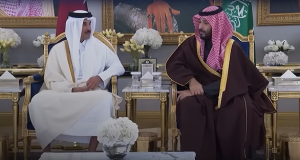 Saudi Crown Prince MBS Welcomes Qatar Emir in Riyadh. Screengrab via Youtube
- The Abraham Accords, once touted as a breakthrough, have quietly moved, in Saudi political conversation, into the deep freeze.
- In September 1967, the Arab League, at its summit in Khartoum, delivered the famous three “no’s”: no peace with Israel, no recognition of Israel, no negotiations with Israel. Notably, the declaration made no mention of a Palestinian state, which the late senior PLO official Zuheir Mohsen significantly pointed out in 1977, had not yet been invented:
- “The Palestinian people does not exist. The creation of a Palestinian state is only a means for continuing our struggle against the state of Israel for our Arab unity. In reality, today there is no difference between Jordanians, Palestinians, Syrians and Lebanese. Only for political and tactical reasons do we speak today about the existence of a Palestinian people, since Arab national interests demand that we posit the existence of a distinct Palestinian people to oppose Zionism.” — Zuheir Mohsen, Trouw, March 31, 1977.
- Once US President Donald J. Trump, without Saudi Arabia lifting a finger, relieved the kingdom of its foremost adversary, Iran, and removed the major threat to the kingdom, what would Saudi Arabia need Israel for anyway? To the Saudis, the Abraham Accords doubtless look like an agreement signed by others, but never embraced by the one Arab power that truly mattered.
- The Arab League’s Khartoum resolution was never truly about borders. It expressed a fundamental rejection of Jewish sovereignty on land the Arab world, guided by religious doctrine, considered permanently to be held in trust (waqf, endowment) for Allah.
- The late Abba Eban, serving as Israel’s foreign minister, had called the pre-1967 “border” — merely an armistice line where the fighting had stopped in 1949 — “the Auschwitz lines.” Riyadh appears to understand this perfectly, which is precisely why its condition was framed as it was.
- The Arab League’s response to the 1948 UN partition plan was a genocidal invasion of the newly born Jewish state by the armies of five Arab states. Khartoum repeated this rejection in 1967. Saudi Arabia continues the same refusal today in language carefully tailored for Western chancelleries.
- Qatar, meanwhile, plays an even more institutionalized double game: hosting America’s largest regional military base while protecting Hamas commanders, financing Muslim Brotherhood networks, and deploying Al Jazeera TV network as the ideological megaphone for the entire project.
- Israeli security cannot rest any hope on a recognition that will not come. It will depend instead on the determined elimination of the Iranian regime and its terrorist proxies when the opportunity arises, and the fight for power that might well define the Sunni world once the Shia threat no longer binds it together.
Riyadh has chosen its words with care, yet the meaning could hardly be more clear. Saudi Arabia will not recognize the State of Israel — not under the present Israeli government and — here comes the poison pill — not before the creation of an independent Palestinian state along the 1949 “Auschwitz” armistice lines, with East Jerusalem as its capital.
The Saudi foreign minister has framed this stance as a strategic principle rather than a negotiating position. A 2025 survey conducted by the Washington Institute for Near East Policy revealed that 99% of Saudi citizens view normalization with Israel as a negative development. The Abraham Accords, once touted as a breakthrough, have quietly moved, in Saudi political conversation, into the deep freeze.


Saudi Arabia is playing the same game as Iran. Wait, delay, wait some more, maybe get some unexpected help with Iran, wait for concessions, wait some more, wash, rinse and repeat. We have seen the Iranians play this game and understand that they have no interest in actually gaining anything because they do not want to promote Israel to an even higher status.
If the Iranians were to ever overthrow their government, they would tend to ally themselves with other Moslem countries, especially Saudi Arabia, and Qatar is not different. If they were to be overthrown, and they are asking for it, they would also tend to cleave to Saudi Arabia rather than to any other allies. The only reason they hosted a US airbase in Qatar was for protection against other Moslems.
For theological reasons, nobody wants to partner with Israel although there are a couple of “peace treaties” out there.
The Turks are a special case. They would also prefer to be allied to Moslem countries but do not want to relinquish the benefits of being in Europe and being a NATO member. However, if we listen to what Erdogan actually says, he is playing the same game as all the other Moslems (see above) waiting for handouts. He was quite happy to be technologically friends with Israel for a while but now feels that he can get along very well, thank you, without Israeli help. Good luck!!
Saudi Arabia not interested to move into modernity!
MBS not in charge. Clerics still in control.