
Oil prices fell immediately upon the announcement
All Israel News | Published: April 7, 2026
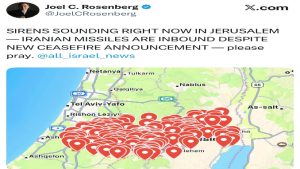
It’s just after 2 a.m. here, and I’m writing this dispatch from inside our bomb shelter.
My wife and I can feel our apartment shaking from the booms of missile interceptions happening overhead.
Please keep praying for the peace of Jerusalem.
That said, with barely one hour to go before his deadline to bomb Iran “back to the Stone Ages” unless they accepted a deal, President Donald J. Trump announced a two-week ceasefire in which the U.S., Israel, and Iran agree to stop attacking each other for 14 days.
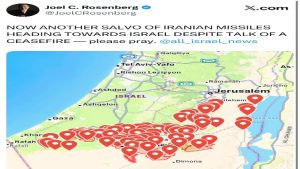
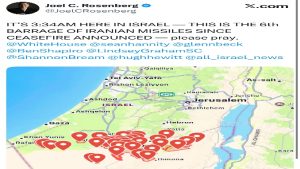
Just minutes after Trump made the announcement, Iran launched a new salvo of missiles at Israel.
It remains to be seen whether the barrages will continue through the night or if the ceasefire will truly begin shortly.
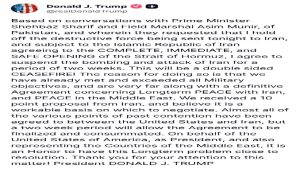 Credit: President Trump’s Truth Social account
Here is the President’s statement:
“Based on conversations with Prime Minister Shehbaz Sharif and Field Marshal Asim Munir of Pakistan — and wherein they requested that I hold off the destructive force being sent tonight to Iran, and subject to the Islamic Republic of Iran agreeing to the COMPLETE, IMMEDIATE, and SAFE OPENING of the Strait of Hormuz — I agree to suspend the bombing and attack of Iran for a period of two weeks,” Trump wrote.
“This will be a double-sided CEASEFIRE!” he added.
“The reason for doing so is that we have already met and exceeded all military objectives and are very far along with a definitive agreement concerning long-term peace with Iran, and peace in the Middle East.”
“We received a 10-point proposal from Iran and believe it is a workable basis on which to negotiate.”
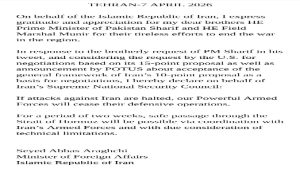
“Almost all of the various points of past contention have been agreed to between the United States and Iran, but a two-week period will allow the agreement to be finalized and consummated.”
“On behalf of the United States of America, as President, and also representing the countries of the Middle East, it is an honor to have this long-term problem close to resolution,” the President concluded.
Oil prices fell by nearly 20% immediately upon the announcement.

“I have all the confidence in the world that @POTUS understands who he’s talking to in Iran and earnestly seeks a diplomatic solution,” Senator Lindsey Graham (R-SC) posted on X shortly after the announcement.
“But it has to be the right deal. President Trump — better than anyone I know — understands how to deal with the toughest of people.”
This is a developing story…


I don’t understand this:
“how does israel pay for gas and oil +6
“Israel pays for imported oil and gas using its foreign currency reserves generated by a strong economy, high-tech exports, and increasing revenue from its own natural gas exports. While 99% of its crude oil is imported from countries like Azerbaijan, Kazakhstan, and Brazil, Israel has achieved domestic natural gas independence.Key Aspects of Israel’s Energy Funding:Oil Imports Funding: Israel imports roughly 220,000 barrels of crude oil daily, primarily funded through private energy sector purchases funded by revenues, with major suppliers including Azerbaijan and Kazakhstan.Domestic Gas Savings: Massive natural gas discoveries (Tamar and Leviathan fields) mean Israel no longer pays for most of its electricity generation fuel, significantly decreasing foreign currency reliance for energy.Gas Export Revenue: Israel generates significant income through long-term export deals. A $35 billion, 15-year deal (as of 2025) to supply natural gas to Egypt provides substantial revenue.Foreign Currency Reserves: Israel’s Bank of Israel maintains significant foreign currency reserves to stabilize the economy and ensure the ability to pay for essential imports, including energy.Sovereign Wealth Fund: Israel uses the “Israeli Citizens’ Fund” to manage and invest royalties from natural gas exports for future economic stability.Note: While Israel is self-sufficient in natural gas, it remains heavily dependent on imports for crude oil (transportation and fuel), which are paid for by commercial entities.”
It looks as if Dimona was a principle target.
I wish you all the best. Am Israel Chai!!