
Peloni
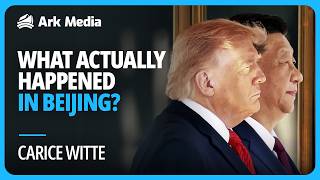 Video Loads Below
In an interview with Dan Senor, SIGNAL’s Carice Witte offers some important context for Trump’s Beijing Summit and describes how it relates to Israel, the Middle East, and the ongoing geopolitical dynamic between China and America. Highlights below video.
- Carice Witte describes China’s relationship with Iran as not a formal alliance but a “marriage of convenience” based on strategic interests.
- Witte argues that China wants the Iranian regime to remain in power because Iran keeps U.S. military attention focused on the Middle East rather than the Indo-Pacific.
- She stated that China benefits from a weakened but still anti-U.S. Iranian regime, while also wanting the Strait of Hormuz to remain open because China depends heavily on energy imports.
- Witte explains that China opposes a nuclear Iran due to it possibly triggering nuclear proliferation not only in the Middle East but also closer to home in Japan and South Korea.
- Witte argues that China projected confidence publicly but failed to secure several key objectives from Trump.
- China hoped the United States would soften its position on Taiwan, including changing language regarding Taiwanese independence, but Trump provided no concessions on these issues.
- The United States maintained its policy of “strategic ambiguity” toward Taiwan and did not cancel planned arms sales to Taiwan.
- Witte described China’s use of the “Thucydides Trap” concept as part of Beijing’s effort to portray China as a rising power and the United States as a declining power.
- Witte described China’s messaging strategy as emphasizing equality with the United States while portraying Xi Jinping as operating from a position of strength.
- Witte notes that China will continue to support Iran economically, which will include purchases of discounted Iranian oil via smaller “teapot” refineries operating outside major international banking systems while likely continuing to help Iran rebuild its missile capabilities through the supply of dual-use materials and technology while publicly denying any direct responsibility.
- Witte argued that China has become more cautious about publicly presenting itself as a Middle East mediator after recent regional conflicts exposed the limits to Chinese influence.
- Witte noted that Israel has gradually become more vocal diplomatically regarding Chinese support for Iran, including hosting Taiwanese officials and criticizing China’s treatment of Uyghurs.
- She explains that Israel has historically pursued two main objectives with China without success:
- Assistance in preventing Iran from becoming nuclear
- Reducing China’s anti-Israel posture at the United Nations.
- After October 7 China sharply increased anti-Israel rhetoric and promoted pro-Iran messaging domestically based on the conclusion that October 7 demonstrated Israel to be a failed state.
- She notes that China’s perception of Israel later shifted after Israeli military and intelligence successes during 2024 and 2025, leading Beijing to recognize Israel as being a stronger regional power, leading to Chinese official statements being more restrained and avoiding direct condemnation of Israel in the later stages of the conflict with Iran.
- The interview also took note of China’s domestic economic challenges, including its slowing growth, rising unemployment among its younger generation, poor consumer spending, demographic decline, and shockingly reduced corporate profit margins.
- Witte stated that Chinese leadership worries that expanding its welfare programs too much could result in reduce incentives for working, taking note of Pres. Xi Jinping’s concerns about becoming “like the British.”
- She argued that China’s foreign policy increasingly emphasizes overseas expansion and export markets to compensate for its weak domestic economic activity.
- Witte suggests Israel could use its growing relationships with countries such as the United Arab Emirates, Japan, Philippines, and India to increase leverage with China.
- She proposes that Israel could publicly endorse a “Free and Open Indo-Pacific” concept, which she described as a strategic signal opposing Chinese expansion in the South China Sea.
- Witte notes that the U.S.-China relationship remains in a kind of managed stalemate while regional conflicts involving Israel and Iran continue evolving.


Leave a Reply
You must be logged in to post a comment.