Europe Tries to Salvage Decades of Integration as Coronavirus Shuts Borders
Road-travel restriction and grounded air transport threaten companies’ abilities to produce and deliver goods and services
By Laurence Norman in Brussels and Drew Hinshaw, WSJ
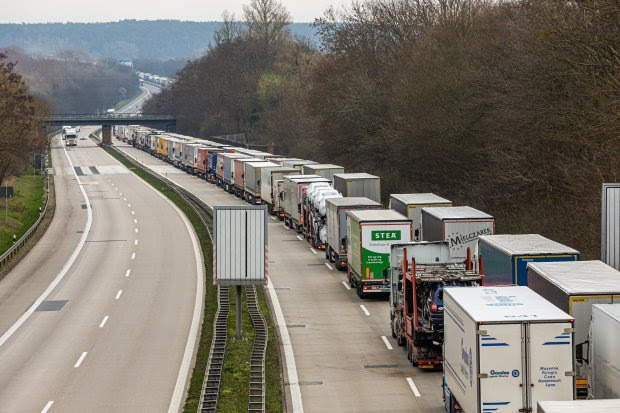
Trucks that once sped across the German-Polish border have been waiting almost a full day to cross.
It took Europe a half-century to integrate its economies. It took the new coronavirus only weeks to roll that back as countries closed their borders.
Across vast fields of the northern Netherlands, the huge springtime flower harvest is wilting because demand has plummeted, export markets closed and seasonal workers can’t cross the border. Luxembourg has struggled to staff hospitals because nearly half its workforce commutes from neighboring countries. Trucks that once sped across the German-Polish border have been sitting almost a full day to cross, sparking spats between drivers and riot police sent to contain the virus.
The European Union, the world’s second-largest economy, was built on free movement of people and goods. For three decades, Europe’s internal market flourished as the bloc expanded and borders fell, bolstering growth. Businesses grew to depend on deeply integrated supply chains and workers who ignore national demarcations inside the bloc.
Read more…